
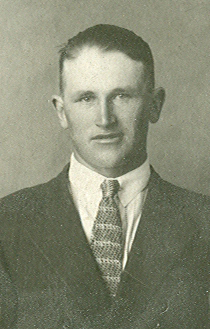
 In about 1918, teen-age Sid had an appendix attack while throwing hay to the animals. They drained so much pus, the doctor said, “Sid, they couldn’t kill you with an axe.” Later he had a double hernia, and kept on working. When his father died, Sid helped provide for the family by contracting his team of horses to haul material for the Magna mill. The superintendent said, “Sid, I want you to sell your teams and come and work at the mill.” Sid replied, “I can’t,” stating that he had a double hernia and no money for an operation. They persisted so he turned his team over and had the operation. After 30 days he went to work but somebody dropped a half-inch rod behind him, he stepped on it, rolled, and tore his side open. “Doctor, what kind of hitch are you going to put on it this time?” The reply? “I’ll fix one so you won’t tear it loose.” With a spinal, Sid talked through the operation hearing the doctor cut threads and such. Afterwards the doctor prescribed, “Just rant around.” “Okay,” Sid said, “you guarantee your job this time?” “You bet,” the doctor insisted. “You can’t tear it.” And he never did. Sid worked at the Magna mill from 1926 to 1945. (by Kenneth R. Hardman. Based on excerpts from Sidney Lehi Hardman & Myrtle Emily Elton: Their Life, Their Love and Their Family, 1900-1991 compiled by Dorothy Hardman. Photo from family files) #AncestorClips
Sidney Lehi Hardman – Tougher than Stitches
1
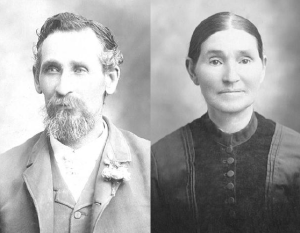 “It was a cold, frosty morning; a barefooted boy, with a skillet in his hands, knocked at the Coons’ door. Grandmother Coon opened their door to stare at the thin, sparsely clad lad. Father stated his errand and she drew him inside. All of the boys and girls of that family slept in the attic, as there was only one large room and an attic for the house at that time. Down the ladder they came to see the stranger, boys and girls in their nightclothes. One, a brown-eyed lass with long dark braids, stared into the soft blue eyes of the black/curly-headed stranger. How often I have heard my father say to my mother, later: ‘When I first saw you, my dear, you were in your nightgown.’ My father met my mother in the fall of 1842, when he was eleven.” (by Amelia Hardman Sadler, daughter of Lehi Nephi and Francis Coon, as included in Goble’s, Heritage of the Coon Family, adapted from family records in Hardman Biographies – Ancestors of Sidney Glenn Hardman and Dorothy Mae Griffin, 2009. Photo from family archives) #AncestorClips
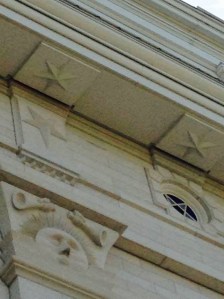 During the industrial revolution, John Hardman, my 3rd great uncle was a young working class mechanic in Manchester, England. Shortly after his father’s death, when apostles came, he recognized the truth, and joined the Latter-day Saints. But false notions and traditions caused him to stumble as a new member. He could have given up but his leader, William Clayton, counselled with him. He was called as a Deacon and Branch clerk. Accepting the prophet’s call, John and Mary set sights to Zion. On the ship Sheffield, mutiny threatened and John and others rallied to the captain’s aid, resolving the conflict, growing in character. They crossed the Atlantic, into the gulf, up the Mississippi, and on to Nauvoo. He worked hard, listened to prophets, was baptized in the river for his father, had a son, and built a home just blocks from the rising Nauvoo Temple. John and Mary were sealed in the House of the Lord; but, mobs raged and took his prophet; illness struck and took his mother and son; hatred swelled and drowned his brother on the Mississippi; suspicion grew and drove out the saints. With little means, John and family went south, to St. Louis. As a Missouri river merchant he equipped saints going west and assisted missionaries going east. A Patriarch promised great posterity, but it wasn’t to be; not in this life. John contracted cholera, and died in St. Louis, his blessings deferred. For now, he was God’s instrument in helping others to Zion.
 Seven years before I was born, in the fall of 1951, the war raged on in Korea. My dad wrote his Sunday letter to mom in California. During the pain of lengthy separation, they grew closer as their heart-felt letters crossed the Pacific. “I enjoyed church this morning,” dad wrote, “mostly I think because I attended the first… meeting since I have been over here. I can’t express in words how wonderful it made me feel. My heart is overflowing with wondrous and glorious thoughts.” As a son, what greater example could I have from my then 23-year-old father? It was during a time of unexpected trial and potential death, that my mom and dad looked to a hopeful future and made plans for a family. They have now passed. Their happy posterity grows as they planned. If they can endure, I can endure; if they can do hard things, I can do hard things. (by Kenneth R. Hardman)
  AncestorClips