

 Phoebe wiped tears from her face as her creek-soaked children happily burst into their small summer home. “Why are you crying,” they asked. Phoebe quickly got them pulling molasses candy as she pushed back on her memories. She was happy with her husband, her children, and her faith, but change was hard. They had joined the Latter-day Saints in England. Back home, Elders had come regularly for cottage meetings, singing songs of Zion. George and Phoebe had a roast feast on the Sabbath, then they would walk up the rolling green pasture amongst the large oaks. As shoe makers he fixed soles and did tacking while she sewed them. He would then walk 10 miles, deliver their work, receive pay, and bring back work for next week. They ate bread and butter, simple black English tea and sometimes bread pudding with sugar and a raisin. Some family members had already immigrated and George had been anxious to take his wife and children. In 1883, they sent little Clara and Lillie to Salt Lake to live with family. A year later, George made the trip. He worked on a farm to earn travel for the rest. A year later, Phoebe set sail with the other 4 and eventually they enjoyed a happy reunion living in Bingham Junction. Phoebe wiped another tear as she looked at her stove. “I miss my cooking fireplace,” she thought. Until beds could be filled with straw or corn shucks, they were simple quilts on the floor. Money was tight for school, so the children often worked away from home, but at least they were together on Sunday afternoons. George worked on the railroad from Midvale to Bingham coming home each day with a sunburned nose in the summer, or an icy mustache in the winter. Having sacrificed some of their English connections for the gospel, George and Phoebe knew that their separations were only temporary. Again with sacrifice, they made a week-long journey to the Logan Temple where their family was united for always.
By Kenneth Richard Hardman, based on material in, Hardman Biographies – Ancestors of Sidney Glenn Hardman and Dorothy Mae Griffin. #AncestorClips
Inherited Traits – Like great-great-grandma and grandpa Clark, I have always been anxious to be with family, and to be united with people of my faith. At the same time, changes have never been easy and I miss my family members when we are separated.
Patterns of Goodness – I can learn from their pattern of hard work as cobblers, farmers, railroad workers, and in raising a large family. They demonstrated patience to get their whole family to Utah, a few at a time. I can apply their patience to the hopes I have for the long term spiritual destinations of my family. Thanks grandma and grandpa Clark for my life, and for your example.
 My great-grandfather William was 11 when his father died, and the English officers came to take him and his four brothers to the poorhouse. “How we clung to mother’s dress,” he said. Isabella was, a little woman. But in faith and work, [she was] a wonder. “Not one of these boys goes,” she said. “Each and everyone will go to Zion.” William had to quit school to sell papers, sweep crossings, and sell milk door-to-door. He worked in a small store, never touching money left laying around by the manager. “I wouldn’t take anything I did not honestly earn,” he said. No one doubted Williams honesty. Encouraged by his mother’s faith and letters. One by one all 7, plus mother made it to the valleys of the Salt Lake. In Utah and Colorado, at age 16 he maintained railroad ties for the Rio Grande, was promoted to surveyor, track foreman, bridge inspector, and conductor, sending every penny he could to his mother while contributing to the college education of his younger brother. On a work assignment he met Rachel Ault at the Cedar Valley station. They later married and ran a boarding house. Self educated, William spoke as though a scholar, brilliant in mathematics. Knowledgeable men often came to him to solve problems. He was happy, shook hands with everyone, did not find fault, and expected his children to respect others, especially their mother, and would not settle for any kind of sloppy job. He honored people, hung photos of servicemen on his wall, and wrote a poem for each funeral in the community. “And my dear loved ones, Lord I pray, protect, direct and guide each day. Dear Lord in truth may I increase, that when my mortal life shall cease, I may be worthy, Lord, with thee, to serve through all eternity.”
 “Lillie and the children were still in bed when Will came rushing into the log home, ‘Fire.’ She grabbed the baby and he carried the little girls out just as the ceiling fell on their bed. There was no water system, so it was soon all gone but a few logs. They made a small room out of these logs, shingled it and moved in before winter.” In time the family grew to 9 children, but it would have been more. Two babies died very young, and one daughter, Birdie, died as a young adult. Each loss was painful. Will worked hard. He was kind and loving, singing with Lillie, playing mouth organs with the boys, whistling while he drove horses, thrashed and sacked wheat. Will was generous when he sold his vegetables, and always had time to wrestle with the boys, and play with the children. “Prayers were always said at the table, everyone on their knees by the chairs that had been turned with their backs toward the table… Lillie… taught the parents class in Sunday School.” She worked hard, loved her family, but had her trials. When baby Blanch died, Lillie wrote, “For a long time, I went around trying to do my work and care for the family, but my heart was broken. With the help of the Lord, I overcame it all, and one morning, as I went to the creek to get a pail of water, the gloom seemed lifted and everything seemed to put on a new life. Those beautiful mountains on the west seemed to be so near and the blue sky overhead. I said to myself, ‘You foolish woman, Look up and thank God for all this beauty that you have been so blind to all these days…’ From then on, things seemed to be more to live for.” Lillie outlived her husband by 40 years. Her son said that her beauty was the kind “that emanates from heart to heart and affects the fiber of each and everyone…”
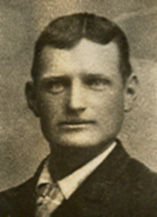 The two-year-old twins, Ellen and William, were excited when the baby came. Olive, was her name. But, 10 days’ later joy was robbed by tears as their mother passed away. William Walker was one of those twins. He was born in the spring of 1870 in Millcreek, Utah to James Craig and Elizabeth Griffiths Walker. Sorely missing their mother, this was a difficult time for the Walkers. The twins were taken in by their mother’s family. Eventually, Will went to live with his older sister, Mary Ann, and he worked in sheep camps as a tender or herder. Raising sheep was a year-round job, shearing in the spring, moving flocks to the mountains in the summer, then to market in the fall. He worked hard and earned a share in a sheep herd. While herding sheep, he no doubt heard of marvels near and far like the typewriter, the telephone, and the transcontinental railroad. It was in fact that railroad that brought the lovely Lillie Clark from far away England. They danced, they courted and they married. William sold his sheep herding share for a ‘wedding stake’ of $200. His first real home was a two-room log hut in the cottonwoods in Salt Lake, with bare floors, a wooden bed with a straw tick, two wool quilts made from his sheep and a companion he loved very much. (To be continued)
  Cheryl Diane Hardman was born in January, 1951. As a brand new baby, she received a blessing by the hand of her father while he was on military training leave, then she didn’t see him again for 16 months while he served overseas for his country. She grew up a bright child. At the age of 3, Knowing that her baby brother loved bananas, Cheryl turned again to the hand of her carpenter dad and said in all seriousness, “Daddy, would you bring home some wood to make a banana tree?” As she grew, Cheryl did what most children did; she rode bikes, got cuts, had stitches, took music lessons, entered science projects and won awards. When older with 5 younger siblings, Cheryl politely told her parents that 6A students, especially the girls, “do not ride their bikes to school anymore. They are too old for that.” As a teen, Cheryl didn’t need to be reminded of homework. She enjoyed classes like typing, seminary, history, English, Spanish, science, and algebra. She even made some of her own clothes. Her favorite TV shows were, The Mouse-ka-teers, and Bonanza. With high hopes, her parents looked forward to great things in life for her. In 1969, fulfilling her college dream, Cheryl slowly developed debilitating symptoms from a disease whose diagnosis evaded doctors until Cheryl could not walk or talk; death was at the door. That year, as mankind overcame great odds and put a man on the moon, Cheryl desperately struggled and with the help of prayers, family, and many doctors, overcame the disease. She finished college, became a teacher, served others with handicaps, married, and raised a great family, thereby touching mankind for good. Thanks Cheryl, you are a great sister.
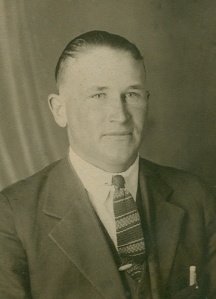 Typical for men in the depression years, Sid worked at whatever he could to keep bread on the table and a roof over the heads of his growing family. He was a “Jack of all trades,” adept at “making do,” mending with bailing wire, keeping things running. Myrtle and Sidney, served in the community and church and enjoyed the growing up years of their children being “mom and dad” to many, supporting them in their activities, inviting them to their home. This continued with grandchildren. They were protective of their children, who never heard “their dad tell a sexy or off-color joke.” He enjoyed a good clean time and liked to see others having a good time too. He pulled bobsled with his team of horses turning that sled round and round, flipping those kids out in the snow. Sid took his family role to heart; he taught, he loved, he scolded, he played, he supported. He and his sweetheart were always on hand for everything; baseball, wrestling, football, softball, proud of the accomplishments of family members. “Sid’s shop was a place of learning and the boys enjoyed working with him. Grandpa was always fussy about keeping his tools in the right place and taking care of things. So it was with his animals: he followed his dad’s training and always took care of the horses, unharnessed them, brushed them down and fed them before he had his own meal.” He was honorable and endured cheerfully throughout his life, a great example to his posterity. (Adapted by Kenneth R. Hardman from Sidney Lehi Hardman & Myrtle Emily Elton: Their Life, Their Love and Their Family, 1900-1991 compiled by Dorothy Hardman. Photo from family files)
 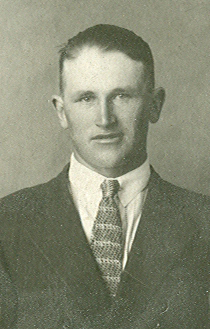 In about 1918, teen-age Sid had an appendix attack while throwing hay to the animals. They drained so much pus, the doctor said, “Sid, they couldn’t kill you with an axe.” Later he had a double hernia, and kept on working. When his father died, Sid helped provide for the family by contracting his team of horses to haul material for the Magna mill. The superintendent said, “Sid, I want you to sell your teams and come and work at the mill.” Sid replied, “I can’t,” stating that he had a double hernia and no money for an operation. They persisted so he turned his team over and had the operation. After 30 days he went to work but somebody dropped a half-inch rod behind him, he stepped on it, rolled, and tore his side open. “Doctor, what kind of hitch are you going to put on it this time?” The reply? “I’ll fix one so you won’t tear it loose.” With a spinal, Sid talked through the operation hearing the doctor cut threads and such. Afterwards the doctor prescribed, “Just rant around.” “Okay,” Sid said, “you guarantee your job this time?” “You bet,” the doctor insisted. “You can’t tear it.” And he never did. Sid worked at the Magna mill from 1926 to 1945. (by Kenneth R. Hardman. Based on excerpts from Sidney Lehi Hardman & Myrtle Emily Elton: Their Life, Their Love and Their Family, 1900-1991 compiled by Dorothy Hardman. Photo from family files) #AncestorClips
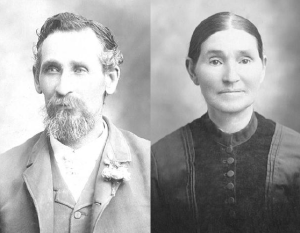 “It was a cold, frosty morning; a barefooted boy, with a skillet in his hands, knocked at the Coons’ door. Grandmother Coon opened their door to stare at the thin, sparsely clad lad. Father stated his errand and she drew him inside. All of the boys and girls of that family slept in the attic, as there was only one large room and an attic for the house at that time. Down the ladder they came to see the stranger, boys and girls in their nightclothes. One, a brown-eyed lass with long dark braids, stared into the soft blue eyes of the black/curly-headed stranger. How often I have heard my father say to my mother, later: ‘When I first saw you, my dear, you were in your nightgown.’ My father met my mother in the fall of 1842, when he was eleven.” (by Amelia Hardman Sadler, daughter of Lehi Nephi and Francis Coon, as included in Goble’s, Heritage of the Coon Family, adapted from family records in Hardman Biographies – Ancestors of Sidney Glenn Hardman and Dorothy Mae Griffin, 2009. Photo from family archives) #AncestorClips
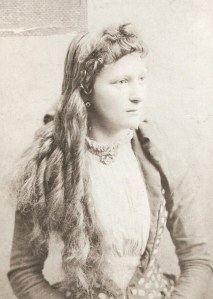 At age 7, my great-grandmother Lillie and her dear 10 year old sister Clara were close, living a happy life together with their hardworking, loving parents and family. “Mother always took pride in our hair,” she wrote. They wore tight braids to bed on Saturday, and went to Sunday School in lovely curls. One day, Lillie learned that Clara would be the first of the family to go to America. Tears prompted her father to borrow money so the two would not be separated. In spring of 1883, they traveled with a missionary from her little village to Liverpool by train, by steamship to America, and by train to Salt Lake City, homesick for family, motherly care, bread and butter (scrape), bread pudding with sugar and raisins, cheese and watercress, and Sunday walks up the green. On arrival they found mosquitoes and a hot rail yard, not streets paved with gold, but they were cared for by their aunts including a hot bath and their hair combed out. Being daughters of shoe makers, they literally stood out, the boys pointing at the “stogies” (stout coarse shoes) on their feet. Lillie was often frightened at night. She learned to sew, attended summer school, and Sunday School. They missed their parents and siblings. A whole year after arrival, word came that father would come, but alone since a new baby required mother, brother and sisters to come later. She missed them all. “One day, Lillie was playing in the kitchen and a large rubber ball with colored pictures rolled across the floor. She looked up to see where it had come from and saw her dear father. She sprang into his arms and tears of gratitude rolled down her cheeks.” (By Kenneth Richard Hardman, adapted from William Wallace & Annie Lillie Clark Walker Book of Remembrance: Their Life, Their Family and Their Story, 1985, compiled by Dorothy Hardman with excerpts from Lillie’s autobiography. Photo from family archives)
 While John and Rachel Tirrell Ault were living in Deseret, Millard Co., Utah their son, little Georgie, wanted to go to Cedar Fort with his uncle, Reuben Coles. His mother said, “I need you, I can’t spare you. Ride a little way with Uncle Reuben and then walk back.” Georgie went with his Uncle over the river, then Georgie came running back to his mother very frightened. He told her he had seen a man all dressed in white, who had looked at him. Georgie said, “I was scared Ma.” His mother said she was so frightened when he told her this that she felt like her hair was standing on end. Later Georgie and his sister, Rachel, went out to the river to catch some fish for supper. While there, their father called Rachel. After telling Georgie to sit still, she ran to her father. When she came back there was no sign of little Georgie. Rachel ran on down the river and told her brother Jack, who was in swimming, what had happened. He jumped out and ran 2 miles bare naked to get a Hales boy who was an excellent swimmer and diver. The Hales boy went to the river and right to the spot where the body of little Georgie was held by willows. Mr. Hales came with his wagon and took the family and the body, to his home in Oasis, Millard Co., Utah and that is where George Ault was buried. The women stayed up all night to make the burial clothes while the men made the casket. The body was laid out on a sheet covered plank with Georgie’s faithful dog lying underneath keeping watch. (By Ina Calton Gilbert, Contributed by Susan Gilbert to
  AncestorClips