
 Cheryl Diane Hardman was born in January, 1951. As a brand new baby, she received a blessing by the hand of her father while he was on military training leave, then she didn’t see him again for 16 months while he served overseas for his country. She grew up a bright child. At the age of 3, Knowing that her baby brother loved bananas, Cheryl turned again to the hand of her carpenter dad and said in all seriousness, “Daddy, would you bring home some wood to make a banana tree?” As she grew, Cheryl did what most children did; she rode bikes, got cuts, had stitches, took music lessons, entered science projects and won awards. When older with 5 younger siblings, Cheryl politely told her parents that 6A students, especially the girls, “do not ride their bikes to school anymore. They are too old for that.” As a teen, Cheryl didn’t need to be reminded of homework. She enjoyed classes like typing, seminary, history, English, Spanish, science, and algebra. She even made some of her own clothes. Her favorite TV shows were, The Mouse-ka-teers, and Bonanza. With high hopes, her parents looked forward to great things in life for her. In 1969, fulfilling her college dream, Cheryl slowly developed debilitating symptoms from a disease whose diagnosis evaded doctors until Cheryl could not walk or talk; death was at the door. That year, as mankind overcame great odds and put a man on the moon, Cheryl desperately struggled and with the help of prayers, family, and many doctors, overcame the disease. She finished college, became a teacher, served others with handicaps, married, and raised a great family, thereby touching mankind for good. Thanks Cheryl, you are a great sister.
(by Ken Hardman, with details from the writings of Dorothy Griffin Hardman) #AncestorClips
Inherited Traits – Cheryl is my oldest sister. We grew up in a happy family inheriting a cheerful outlook from our parents. I have a special inherited connection with Cheryl and the courage with which our parents helped her fight disease, and the determination with which she battled and overcame that disease has been a life long strength to me.
Patterns of Goodness – As I reflect on Cheryl’s life, I realize that she had many patterns of goodness. She taught in several schools including schools for handicapped children. She was a loving and good mother. During the first months of my LDS mission away from home, Cheryl and her good husband Steve suggested they go with mom and dad regularly to the temple, another act of service. I needed their prayers and those blessings as a young missionary. I need to be more like Cheryl and write letters regularly to people to lift and strengthen them. I will always look up to my sister. What are your memories of Cheryl?
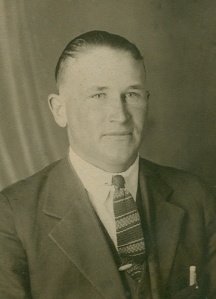 Typical for men in the depression years, Sid worked at whatever he could to keep bread on the table and a roof over the heads of his growing family. He was a “Jack of all trades,” adept at “making do,” mending with bailing wire, keeping things running. Myrtle and Sidney, served in the community and church and enjoyed the growing up years of their children being “mom and dad” to many, supporting them in their activities, inviting them to their home. This continued with grandchildren. They were protective of their children, who never heard “their dad tell a sexy or off-color joke.” He enjoyed a good clean time and liked to see others having a good time too. He pulled bobsled with his team of horses turning that sled round and round, flipping those kids out in the snow. Sid took his family role to heart; he taught, he loved, he scolded, he played, he supported. He and his sweetheart were always on hand for everything; baseball, wrestling, football, softball, proud of the accomplishments of family members. “Sid’s shop was a place of learning and the boys enjoyed working with him. Grandpa was always fussy about keeping his tools in the right place and taking care of things. So it was with his animals: he followed his dad’s training and always took care of the horses, unharnessed them, brushed them down and fed them before he had his own meal.” He was honorable and endured cheerfully throughout his life, a great example to his posterity. (Adapted by Kenneth R. Hardman from Sidney Lehi Hardman & Myrtle Emily Elton: Their Life, Their Love and Their Family, 1900-1991 compiled by Dorothy Hardman. Photo from family files)
 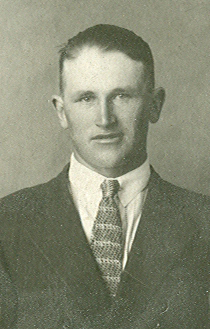 In about 1918, teen-age Sid had an appendix attack while throwing hay to the animals. They drained so much pus, the doctor said, “Sid, they couldn’t kill you with an axe.” Later he had a double hernia, and kept on working. When his father died, Sid helped provide for the family by contracting his team of horses to haul material for the Magna mill. The superintendent said, “Sid, I want you to sell your teams and come and work at the mill.” Sid replied, “I can’t,” stating that he had a double hernia and no money for an operation. They persisted so he turned his team over and had the operation. After 30 days he went to work but somebody dropped a half-inch rod behind him, he stepped on it, rolled, and tore his side open. “Doctor, what kind of hitch are you going to put on it this time?” The reply? “I’ll fix one so you won’t tear it loose.” With a spinal, Sid talked through the operation hearing the doctor cut threads and such. Afterwards the doctor prescribed, “Just rant around.” “Okay,” Sid said, “you guarantee your job this time?” “You bet,” the doctor insisted. “You can’t tear it.” And he never did. Sid worked at the Magna mill from 1926 to 1945. (by Kenneth R. Hardman. Based on excerpts from Sidney Lehi Hardman & Myrtle Emily Elton: Their Life, Their Love and Their Family, 1900-1991 compiled by Dorothy Hardman. Photo from family files) #AncestorClips
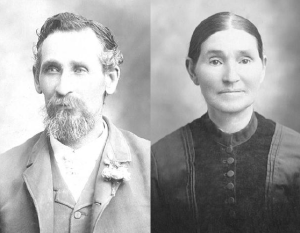 “It was a cold, frosty morning; a barefooted boy, with a skillet in his hands, knocked at the Coons’ door. Grandmother Coon opened their door to stare at the thin, sparsely clad lad. Father stated his errand and she drew him inside. All of the boys and girls of that family slept in the attic, as there was only one large room and an attic for the house at that time. Down the ladder they came to see the stranger, boys and girls in their nightclothes. One, a brown-eyed lass with long dark braids, stared into the soft blue eyes of the black/curly-headed stranger. How often I have heard my father say to my mother, later: ‘When I first saw you, my dear, you were in your nightgown.’ My father met my mother in the fall of 1842, when he was eleven.” (by Amelia Hardman Sadler, daughter of Lehi Nephi and Francis Coon, as included in Goble’s, Heritage of the Coon Family, adapted from family records in Hardman Biographies – Ancestors of Sidney Glenn Hardman and Dorothy Mae Griffin, 2009. Photo from family archives) #AncestorClips
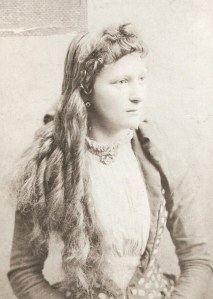 At age 7, my great-grandmother Lillie and her dear 10 year old sister Clara were close, living a happy life together with their hardworking, loving parents and family. “Mother always took pride in our hair,” she wrote. They wore tight braids to bed on Saturday, and went to Sunday School in lovely curls. One day, Lillie learned that Clara would be the first of the family to go to America. Tears prompted her father to borrow money so the two would not be separated. In spring of 1883, they traveled with a missionary from her little village to Liverpool by train, by steamship to America, and by train to Salt Lake City, homesick for family, motherly care, bread and butter (scrape), bread pudding with sugar and raisins, cheese and watercress, and Sunday walks up the green. On arrival they found mosquitoes and a hot rail yard, not streets paved with gold, but they were cared for by their aunts including a hot bath and their hair combed out. Being daughters of shoe makers, they literally stood out, the boys pointing at the “stogies” (stout coarse shoes) on their feet. Lillie was often frightened at night. She learned to sew, attended summer school, and Sunday School. They missed their parents and siblings. A whole year after arrival, word came that father would come, but alone since a new baby required mother, brother and sisters to come later. She missed them all. “One day, Lillie was playing in the kitchen and a large rubber ball with colored pictures rolled across the floor. She looked up to see where it had come from and saw her dear father. She sprang into his arms and tears of gratitude rolled down her cheeks.” (By Kenneth Richard Hardman, adapted from William Wallace & Annie Lillie Clark Walker Book of Remembrance: Their Life, Their Family and Their Story, 1985, compiled by Dorothy Hardman with excerpts from Lillie’s autobiography. Photo from family archives)
 While John and Rachel Tirrell Ault were living in Deseret, Millard Co., Utah their son, little Georgie, wanted to go to Cedar Fort with his uncle, Reuben Coles. His mother said, “I need you, I can’t spare you. Ride a little way with Uncle Reuben and then walk back.” Georgie went with his Uncle over the river, then Georgie came running back to his mother very frightened. He told her he had seen a man all dressed in white, who had looked at him. Georgie said, “I was scared Ma.” His mother said she was so frightened when he told her this that she felt like her hair was standing on end. Later Georgie and his sister, Rachel, went out to the river to catch some fish for supper. While there, their father called Rachel. After telling Georgie to sit still, she ran to her father. When she came back there was no sign of little Georgie. Rachel ran on down the river and told her brother Jack, who was in swimming, what had happened. He jumped out and ran 2 miles bare naked to get a Hales boy who was an excellent swimmer and diver. The Hales boy went to the river and right to the spot where the body of little Georgie was held by willows. Mr. Hales came with his wagon and took the family and the body, to his home in Oasis, Millard Co., Utah and that is where George Ault was buried. The women stayed up all night to make the burial clothes while the men made the casket. The body was laid out on a sheet covered plank with Georgie’s faithful dog lying underneath keeping watch. (By Ina Calton Gilbert, Contributed by Susan Gilbert to
  On April 8, 1921, the day after her 18th birthday, Ardella Anderson retired to her room where she boarded and worked, near the Malad, Idaho train depot. The caretakers, the Pecks, had gone out for the evening, the children were bathed and put to bed. Thinking she might not hear them when her hosts returned late, she went to the kitchen and uncharacteristically unlocked the kitchen door then returned to her bedroom. The spring night air was pleasant so she opened her window half way. At a quarter to twelve she awoke suddenly. A man stood in the bedroom doorway. Ardella had many friends and together they had frequent fun in the late hours dating, dancing, buggy and car riding. But this man’s dark shape, silhouetted by the dining room light, was not familiar. He stepped forward, staring down at her. She shuttered, gazing up at him. She tried to scream. He hit her in the jaw with his fist. She called for Mr. Peck, knowing he wasn’t home. The intruder stopped, backed away, ran through the door, turned out the light, and left the house. Ardella was shaken, but got the courage to run to the kitchen and lock the door. She returned to her bed. The Pecks finally came home, and learning of the intrusion, called the Sherriff who made an unsuccessful search for the man. Ardella, the friendly and smart school valedictorian, was never alone at night again. (By Kenneth R. Hardman, based on, “The Diary of Ardella Elizabeth Anderson Losee,” written from 1919 to 1929, transcribed by Jana Greenhalgh) #AncestorClips
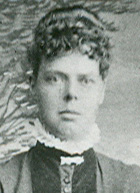 “Grandmother, Rachel Ault Elton, was born April 19, 1859, at Stony Stratford, Buckingham, England… She was the third child of a family of thirteen children. Through misfortune of one type or another, Grandma had only two sisters and one brother who lived to adulthood. When Grandma was only five years old, her folks decided to leave England and come to Zion. They sailed from Liverpool on September 3, 1873, on the Steamship Wyoming. Mr. John B. Fairbank was the captain of the ship. In addition to her parents, two brothers, and a baby sister, there were 410 saints on the ship. Even though Grandma was very young, she remembered and has often told of how they barely escaped shipwreck when the ship became lodged one night on a large sand bar near the Sabel Islands (300 km southeast of Halifax, Nova Scotia). On this occasion everyone was called from their beds to the deck and asked to kneel in prayer. After praying for safety, they all crowded to one end of the deck, and with human balance, they dislodged the ship from the sand-bar. I am sure that it was only the result of their praying and the will of our Father in Heaven that saved them.” (By Beverly Elton Hunt and others as compiled in Hardman Biographies – Ancestors of Sidney Glenn Hardman and Dorothy Mae Griffin, 2009. Photo from family archives)
 Shortly after his birth in 1898, WT Griffin, named after his father and the poet Tennyson, moved from Newton, Utah to Indian Valley, Idaho to homestead. Life was hard living off the land, raising grain and livestock. At age five or six, WT was driving a three-horse plow. Other children were born and the family prospered on their expanding ranch, sawmill, and blacksmith shop. It was hard work, but generally a happy time. At a very young age, WT learned lessons of faith from his parents. The Griffins were active in church and respected by the community. WT wrote, “Father was Presiding Elder… One day… one of the members told father that his family was in destitute circumstances, that he had earned a few dollars, which would be barely enough to buy groceries for his family. If he paid the money out for groceries he would have to wait to pay some tithing which he owed. What should he do? He felt his family should come first. Dad didn’t agree. He said, ‘You pay your tithing and we’ll see what we can do about the other.’ The thing which impressed me,” WT said, “was that the man paid his tithing and his family survived the winter very nicely… When I earned my first dollar, I… paid ten [pennies] tithing… Since that time I have been doing the same… I’ve never missed the money…”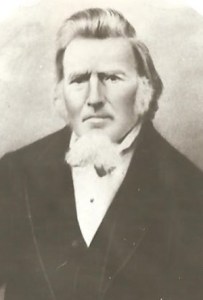
 In about 1841, with their new Mormon faith and seven children under the age of eleven, my 3rd great grandparents, Abraham and Elizabeth Coon experienced the heavy persecutions that drove the Latter-day Saints from Missouri. More children came in Nauvoo Illinois but one died in infancy. As persecution followed them to Nauvoo, Abraham and Elizabeth headed west with the Saints. With her support, Abraham served as bishop, never turning away the needy, experiencing “wagon accidents, diseases, Indians, tough river-crossings, loss of cattle and wagons, and many deaths.” He served as a captain of ten, and looked after several families whose husbands or fathers were called away in the Mormon Battalion. Although losing four of ten children in death, one as a baby, and three as older teenagers including one to cholera, they pressed forward to the Salt Lake Valley. Thank you Abraham and Elizabeth for your faith, honor, service and hard work.
 AncestorClips