
 “Lillie’s life was not an easy one, but she knew how to find joy in work, in her family, friends, in service to others and many other little things. She loved the beauty around her and worked to keep her garden and flowers a delight to all who came to call. She created beauty with her hands, sewing many quilts as gifts and as a means of support for herself. One year, 1948 she quilted 26 quilts, made three more tops, braided and hooked 10 rungs and tatted four hankies. In July 1956 she got prizes on two of the three hooked rugs at the county fair. Her hands were never idle, and she gave of herself diligently to make life happier for those around her. [She] worked hard through her widowed years to sustain herself. She cared for mothers and their new babies, spending ten long nights and days for $25.00; the size of the family was no problem for her… While spending the last of her mortal life at Edna’s and Elmer’s just three nights before she died, as they knelt to have their family prayer, she said, ‘Let me pray tonight.’ And mind you she was very sick at this time. She said, ‘Dear Father, I am ready to die, and I want you to send my husband to get me…’ ”
Source
Excerpt from Life Histories of William Wallace and Annie Lillie Clark Walker, Compiled by Dorothy Griffin Hardman, a grand-daughter, August 2001. “This shortened version was compiled by Dolores for her own children and grandchildren.” Website accessed Sep. 2, 2017: http://www.familysearch.org/photos/artifacts/21838656
Framed photo, poem, and quilt piece: In possession of and imaged by Ken Hardman, great-grand-son. I presume that I received this framed work from my mother, Dorothy Hardman. I do not know whether she created the framework, or received it perhaps from her mother, Ella Mae Walker.
#AncestorClips
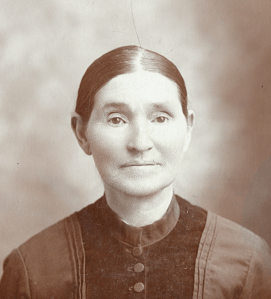 In 1848, five-year-old Francis Ann Coon and her siblings tried to cross the Garner pasture, but the bull saw them and charged. They ran for safety. Her sister “Permilia…climbed [a] tree and…[her brother] John handed all the younger children up before he climbed up himself” narrowly escaping the animals wrath.1 The Coon family, in route from Nauvoo to Council Bluffs was selected to go with the first pioneers to the Salt Lake Valley, but then Brigham Young assigned father Abraham Coon to remain a few years in Pottawattamie “to run a mill and help provide for the Saints…”2 The “corn was scarce,” but the “bluffs, glens, and running streams” were “picturesque.”3 Francis observed her father, Bishop Coon,4 a former member of the Nauvoo Legion and guard to Joseph Smith, faithfully help operate the Indian Mill on Big Mosquito Creek and care for families whose men had gone to serve in the Mormon Battalion2 including William Garner, the likely owner of the bull.3 At this young age, Francis experienced the faith of her parents, their determination to be endowed in the temple before leaving Nauvoo,2 and their sealing in Winter Quarters.5 After fulfilling their assignment in Iowa, Francis and her family walked1 most of the way to Salt Lake to carry out their hopes and dreams in Zion. It was in Salt Lake where Francis would meet her future husband.
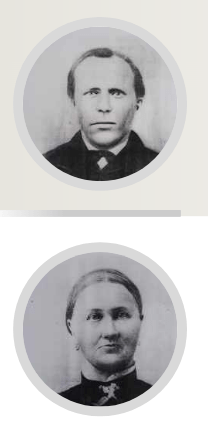 Dusty Roads – by Brent Greenhalgh (a tribute song to Jacob and Maria)
 I have been reading biographies and autobiographies about my wife’s ancestors,
  On the farm young Ferril was taught by his father “to work hard and be a good person.” In addition to farming, football, dancing and music, Ferril was good “with [his] hands and could do construction and other tasks… The principal… once said, ‘I never had a son, but if I had I would like him to be just like you.’” Before graduating, with books in hand he hitchhiked each afternoon to learn about electricity and motors at a vocational school. With good grades in science, Ferril received a scholarship to BYU. He completing his undergraduate work at the University of Utah in his strongest subject, electrical engineering, where he “helped to run a student/faculty lounge, where we would electrocute hot dogs—the best hot dogs you ever tasted—with our electrical gismos.” In 1953 he earned his bachelor of science degree, complimented by the Outstanding Engineering Graduate award from the Institute of Radio Engineering, and received job offers from all seven of the companies with which he interviewed. Ferril chose Hughes Aircraft Company where he, “invented things and headed up the first satellite communications group,” completed his master of science degree at the University of Southern California, and for six years “did other things that were exciting.” At Aeroneutronics he “had an enviable record of getting new business, and that was very good for [him] financially.” After another 6 years, “I was shocked,” when “I received an offer to be the Chairman of the Electrical Engineering Department,” at BYU. He built what “eventually became one of the outstanding electrical engineering schools in the country.” Ferril taught for a couple decades and consulted for government agencies and industries. His specialties were radio, radar, and x-ray. In his retirement, he wrote two successful editions of an engineering textbook, in which he wrote, “there is both a desire and a need to learn about this important subject as completely and as easily as possible.”
 “Grandfather always had such lovely flowers. He took
  Then I went in. Grandfather met me first.
  (by Mary Elizabeth Losee Olsen, about her grandparents, Andrew and Anna Maria Peterson
 “I was 22 years… old when my first babe was placed in my arms… We arrived at the hospital just before 6 PM… The night was long and the pains were hard. My husband… was kind and attentive. ‘When, oh when would my baby come?’ I was a little frightened. I…pulled [at my husband] when those pains struck me. I had been with my mother when her last two babies were born and… realized a very small percentage of what took place at childbirth. Finally, as the wee hours… crept in, I was taken to the delivery room; nurses and doctors all in white. I was so tired and the pains more severe… I was to breathe deeply the stuff they put into the mask… I remember the roaring noise as I swiftly went down a flume that was taking me on and on, so quickly and so far away. The next thing I knew, I was… in a nice clean bed, a nurse nearby, my husband sitting near me. It was almost 7:30 AM of May 17, 1924. ‘Is my baby all right?’ Junior was born at 6:00 AM, a beautiful baby, 6 pounds, 2 oz.… [The nurse] laid that little gift from heaven in my arms, and his tiny little fingers were touched by mine. Oh, what a beautiful baby, and he is all mine. I am a mother, and my husband is the father. [Soon] we went to town and bought a Pullman baby carriage, the nicest one in Ogden city. It was a beauty. I had the most beautiful baby boy, and I was indeed proud of him. I sewed his clothes; thanksgiving was in every stitch. I made him two-piece suits and always a cute bow tie and cap. As he got to walking age, his hair was blond and very curly. Everyone stopped to admire him. He was a good baby.”
 “Walter and Ben, were brought home shot in the legs,” the wagon jolt having discharged a gun. Ben lost his leg but Walter recovered. Their mother, Ruth Keep Griffin was acquainted with difficulty but met life with courage and a smile, likely influenced as a child by the faith of her family. “One night while grandmother Keep was in bed, her oldest daughter, Mary, came to her bedside and asked what she could get for supper as there was nothing in the house to eat. Grandmother answered, ‘Set the table, child, and the Lord will provide.” Just then there came a knock at the door. When Mary opened it, an old gentleman friend of Grandfather Keep’s came into the room. When he learned the condition of want they were in, he put his hand into his pocket and handed Aunt Mary money to get them all something to eat.” Ruth came from England to America at age 11. She worked, and developed skills. She met and married the faithful and hardworking John Griffin. Starting in a dirt floor log house they pieced together furniture as they build their family having eventually 13 children. She lost her hearing, but not her smile. She was the family gardener. “Flowers couldn’t help but grow for her with the care she gave them.” She sang, she danced, she joked, she knitted. They were a united family, in sorrow and joy. She was a radiant flower of Newton, Utah till she died at the age of 77.
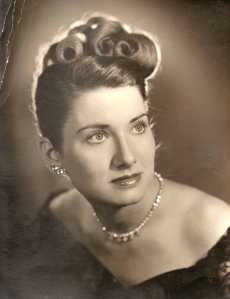 During the boom-town 1950s in Los Angeles, Dona Hansen, the queen of the church Gold and Green Ball, and daughter of a self educated businessman and a most charitable mother, culminated her youth in what she thought would be the crowning event, marriage to a promising man. A short time later while anticipating their first born, her husband left her. She was devastated. “I didn’t think anyone would want to marry a divorced woman with a little son,” she thought. Dona prayed as she always did, was blessed by the prayers of others, and remained “close to [her] Father in Heaven and Savior.” Some time later Dona received a proposal of marriage from a man not of her faith, and she went away to Salt Lake City to consider her future seeking direction in the Temple. She felt inspired to return to Los Angeles. Upon her return, she felt and knew that he was not the one. To her surprise, her fiancé informed her, “I have just met a fellow at church. In fact, he is just what you are looking for.” Driven by the Spirit of the Lord, she stood in church and bore her testimony. Her fiancé and friend Ferril Losee were in attendance. Ferril thought, “She is wonderful but… to good for me.” A short time later, noting the absence of the ring, Ferril asked Dona out on a date. They drove to the beach where, as the sun set upon a beautiful day, the sun rose on a glorious union. Ferril said that he “would be the happiest man on earth if [Dona] would consent to marry him.” Dona knew the Lord was in it, and agreed. (by Kenneth Hardman, adapted from, Losee, Ferril A.,
 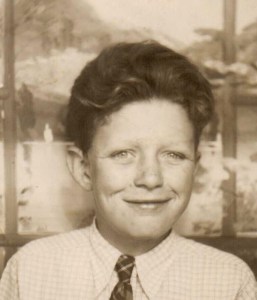 “One day when… 14 years old, I was on top of a load of hay. In crossing over a bridge some of the hay was grassy and moved on me. I put the reins to the horses over the ladder and went back with a pitch fork to straighten the hay. The horses lunged forward and pulled the reins off of the ladder. Then, they ran down a hill, pulling the wagon with them. I could not guide or stop them. They ran faster and faster… I jumped off the wagon which was moving at high speed just before we got to the highway. A big… freight truck… plowed into the side of the wagon. It killed one of the horses and seriously hurt the other…I avoided serious injury… [but] was very sad… I doctored the injured horse every day for about three months. It finally healed. I learned compassion and dependability in doctoring that horse.”
 AncestorClips