
 “Lillie’s life was not an easy one, but she knew how to find joy in work, in her family, friends, in service to others and many other little things. She loved the beauty around her and worked to keep her garden and flowers a delight to all who came to call. She created beauty with her hands, sewing many quilts as gifts and as a means of support for herself. One year, 1948 she quilted 26 quilts, made three more tops, braided and hooked 10 rungs and tatted four hankies. In July 1956 she got prizes on two of the three hooked rugs at the county fair. Her hands were never idle, and she gave of herself diligently to make life happier for those around her. [She] worked hard through her widowed years to sustain herself. She cared for mothers and their new babies, spending ten long nights and days for $25.00; the size of the family was no problem for her… While spending the last of her mortal life at Edna’s and Elmer’s just three nights before she died, as they knelt to have their family prayer, she said, ‘Let me pray tonight.’ And mind you she was very sick at this time. She said, ‘Dear Father, I am ready to die, and I want you to send my husband to get me…’ ”
Source
Excerpt from Life Histories of William Wallace and Annie Lillie Clark Walker, Compiled by Dorothy Griffin Hardman, a grand-daughter, August 2001. “This shortened version was compiled by Dolores for her own children and grandchildren.” Website accessed Sep. 2, 2017: http://www.familysearch.org/photos/artifacts/21838656
Framed photo, poem, and quilt piece: In possession of and imaged by Ken Hardman, great-grand-son. I presume that I received this framed work from my mother, Dorothy Hardman. I do not know whether she created the framework, or received it perhaps from her mother, Ella Mae Walker.
#AncestorClips
 Phoebe wiped tears from her face as her creek-soaked children happily burst into their small summer home. “Why are you crying,” they asked. Phoebe quickly got them pulling molasses candy as she pushed back on her memories. She was happy with her husband, her children, and her faith, but change was hard. They had joined the Latter-day Saints in England. Back home, Elders had come regularly for cottage meetings, singing songs of Zion. George and Phoebe had a roast feast on the Sabbath, then they would walk up the rolling green pasture amongst the large oaks. As shoe makers he fixed soles and did tacking while she sewed them. He would then walk 10 miles, deliver their work, receive pay, and bring back work for next week. They ate bread and butter, simple black English tea and sometimes bread pudding with sugar and a raisin. Some family members had already immigrated and George had been anxious to take his wife and children. In 1883, they sent little Clara and Lillie to Salt Lake to live with family. A year later, George made the trip. He worked on a farm to earn travel for the rest. A year later, Phoebe set sail with the other 4 and eventually they enjoyed a happy reunion living in
 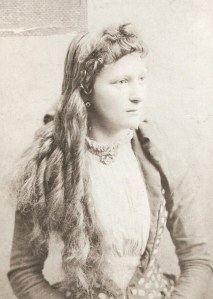 At age 7, my great-grandmother Lillie and her dear 10 year old sister Clara were close, living a happy life together with their hardworking, loving parents and family. “Mother always took pride in our hair,” she wrote. They wore tight braids to bed on Saturday, and went to Sunday School in lovely curls. One day, Lillie learned that Clara would be the first of the family to go to America. Tears prompted her father to borrow money so the two would not be separated. In spring of 1883, they traveled with a missionary from her little village to Liverpool by train, by steamship to America, and by train to Salt Lake City, homesick for family, motherly care, bread and butter (scrape), bread pudding with sugar and raisins, cheese and watercress, and Sunday walks up the green. On arrival they found mosquitoes and a hot rail yard, not streets paved with gold, but they were cared for by their aunts including a hot bath and their hair combed out. Being daughters of shoe makers, they literally stood out, the boys pointing at the “stogies” (stout coarse shoes) on their feet. Lillie was often frightened at night. She learned to sew, attended summer school, and Sunday School. They missed their parents and siblings. A whole year after arrival, word came that father would come, but alone since a new baby required mother, brother and sisters to come later. She missed them all. “One day, Lillie was playing in the kitchen and a large rubber ball with colored pictures rolled across the floor. She looked up to see where it had come from and saw her dear father. She sprang into his arms and tears of gratitude rolled down her cheeks.” (By Kenneth Richard Hardman, adapted from William Wallace & Annie Lillie Clark Walker Book of Remembrance: Their Life, Their Family and Their Story, 1985, compiled by Dorothy Hardman with excerpts from Lillie’s autobiography. Photo from family archives)
 AncestorClips