
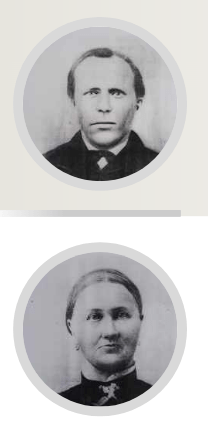
 In 1869, Andrew’s mother died before his 1st birthday. His father, Lars Anderson, with baby Andrew, made the trip from Sweden to Utah in just 30 days, on steamship and railroad. Andrew was left in the care of Lar’s sister, in St. Johns, Idaho, while Lars took work 150 miles south in the Utah Bingham mines. By 8 years of age Andrew was driving oxen and working the cornfields in Idaho. For the next 8 years, Andrew lived with or near his father in Utah who took him to his first store and bought him clothing and a suit. In Utah, Andrew earned meager wages herding sheep and cattle and working in the mines. He attended school for six months and learned to read the Bible. At age 17 he returned to Idaho continuing sheep herding. At age 23, his sick father asked him to come back to Utah. Shortly after Andrews arrival, Lars died of miner’s consumption, and Andrew paid for the burial. Andrew joined the LDS church at age 25 and had $800 from successful sheep herding. He was called to serve a mission, but declined indicating that “those better off should go,” wishing later, “that he had accepted the call.” Instead, he spent the $800 on more sheep, and he took a bank loan for horses and equipment. In a major spring snowstorm, after “the sheep were sheared and had lambs by their sides,” he lost them all in four feet of snow. He honorably reported to the bank, whereupon they took all his assets except for one saddle horse. Broke, and broken hearted, he returned to Idaho, obtained work shearing sheep, started over, and met the girl who would take him to the next level.
(By Kenneth R. Hardman, based on Losee, Ferril A., South, Betty, The Anderson and Josephson Family History – Ancestors and Descendants of Lars Anderson and Anna Andersdotter, Lars Charles and Anna Isaacson Josephson, 1999, pages 14, 53-55, photo from family files) #AncestorClips
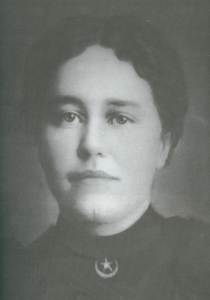 Hannah Elizabeth Josephson, came into the world (St. John, Idaho, to be exact) on November 27, 1877, 2 days before Thanksgiving. She was the 3rd of 12 children born to Lars and Anna Josephson, immigrants from Sweden. There was great love and respect in this large but united family. They were known as “one of the best behaved in the valley.” Hannah was a “pretty brunette,” industrious, and “of a cheerful and religious disposition.” “I used to pray every day and trusted in the Lord,” she said. “I had my prayers answered many times.” The children were taught reading, writing, arithmetic, and geography by their mother, so Hannah was well prepared to enter school at age 6, and continued through the 8th grade. In 1887, nearly all family members including her father had a brush with Typhoid Fever. Three months of dedicated nursing and service by the church and community pulled them through. There were no deaths in the family, but her brother Levi stuttered badly the rest of his life. Hannah was baptized in 1891. She was inspired by her parent’s faith and devotion. “Many times I saw [my father] ride on horseback a distance of 15 miles to attend priesthood meeting. My whole family was religious at heart.” Hannah served as 2nd Counselor in the Young Ladies Mutual Improvement Association at age 18, admired church leaders, and remained active all her days. She too, had many admirers. While courting the man of her choice, “Hannah gave [him] to understand that her husband had to be worthy to take her to the temple.”
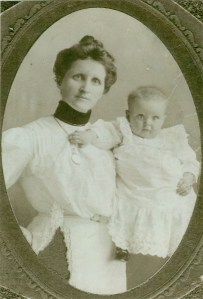 “In the spring of 1908, Dad was called on a mission to Norway. Mother and five children were left home. In the spring of 1909, Edna was stricken with pneumonia, so the doctors thought. It later was diagnosed as spinal meningitis. One cold wintry night, Mrs. Williams, a neighbor, came over to help mother as Edna was so ill. It was almost midnight when Mrs. Williams said, ‘I am afraid she is gone.’ Mother put her head under the mattress and cried ‘No Dear God, no!’ I had been taught about prayer and about the elders of the Church. So I ran a half a block up the street to Bro. George R. Emery with bare feet and snow up to my knees, and asked if he would come and bless my sister. He put his coat over his long night shirt and carried me home. As he put his hands on Edna’s head and started to pray, I stood by and watched her little white face so still. All of a sudden, little red streaks started up from her mouth and then a gasp. She relaxed into a sleep for the first time in weeks. This was my first testimony and answer to prayer and I knew God heard and answered prayers … Edna was always very precious to me from then on. My interests were always for her.”
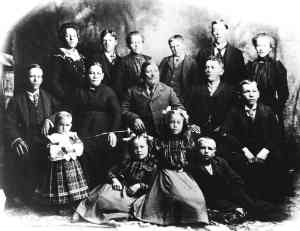 Lars Josephson came by train…to Brigham City. There he worked on the railroad…then drifted northward and took up a 160-acre farm at St. John, Idaho…He got a job in Star and Marsh valleys to pay for a yoke of black oxen…Crossing the Bear River, one of the oxen got stuck in quick sand and they were unable to save him, so he had to work some more…He married Anna Isaacson in 1871 in Salt Lake City in the Endowment House. They…had 12 children: 4 girls and 8 boys. He was quite a religious man and [rode] 15 miles to Portage to Priesthood meetings and went to Malad to conferences…They dug an 80-foot well and drew the water up in buckets. He was a shoemaker…and made all the…harnesses they used–also mended shoes for the neighbors. He helped build 2 reservoirs and had good water rights for his farm. His home, barns and sheds were all made of logs which he hauled…by ox team…He had to haul his crops long distances to Corrine to the railroad…very long cold trips of two and three days and they had to sleep by a campfire in all kinds of weather…They always had plenty of flour, cured meats, honey, fruits, and vegetables and large cheeses. He was generous and shared much with his neighbors…[On] December 2, 1902, their home burned to the ground. They saved a few things and the people turned out and helped build a two-roomed log house in a short time with some logs Charles had there. They lived in a tent until the house was finished…He was of normal temperament and seemed to have a good understanding of the gospel. He had a lot of friends, and his family was well behaved. He loved his horses and drove them on a trot and sang as he went.”
 “Lillie’s life was not an easy one, but she knew how to find joy in work, in her family, friends, in service to others and many other little things. She loved the beauty around her and worked to keep her garden and flowers a delight to all who came to call. She created beauty with her hands, sewing many quilts as gifts and as a means of support for herself. One year, 1948 she quilted 26 quilts, made three more tops, braided and hooked 10 rungs and tatted four hankies. In July 1956 she got prizes on two of the three hooked rugs at the county fair. Her hands were never idle, and she gave of herself diligently to make life happier for those around her. [She] worked hard through her widowed years to sustain herself. She cared for mothers and their new babies, spending ten long nights and days for $25.00; the size of the family was no problem for her… While spending the last of her mortal life at Edna’s and Elmer’s just three nights before she died, as they knelt to have their family prayer, she said, ‘Let me pray tonight.’ And mind you she was very sick at this time. She said, ‘Dear Father, I am ready to die, and I want you to send my husband to get me…’ ”
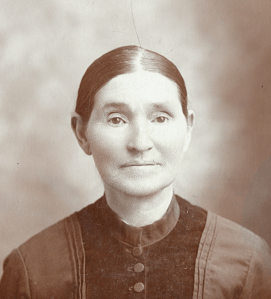 In 1848, five-year-old Francis Ann Coon and her siblings tried to cross the Garner pasture, but the bull saw them and charged. They ran for safety. Her sister “Permilia…climbed [a] tree and…[her brother] John handed all the younger children up before he climbed up himself” narrowly escaping the animals wrath.1 The Coon family, in route from Nauvoo to Council Bluffs was selected to go with the first pioneers to the Salt Lake Valley, but then Brigham Young assigned father Abraham Coon to remain a few years in Pottawattamie “to run a mill and help provide for the Saints…”2 The “corn was scarce,” but the “bluffs, glens, and running streams” were “picturesque.”3 Francis observed her father, Bishop Coon,4 a former member of the Nauvoo Legion and guard to Joseph Smith, faithfully help operate the Indian Mill on Big Mosquito Creek and care for families whose men had gone to serve in the Mormon Battalion2 including William Garner, the likely owner of the bull.3 At this young age, Francis experienced the faith of her parents, their determination to be endowed in the temple before leaving Nauvoo,2 and their sealing in Winter Quarters.5 After fulfilling their assignment in Iowa, Francis and her family walked1 most of the way to Salt Lake to carry out their hopes and dreams in Zion. It was in Salt Lake where Francis would meet her future husband.
 Dusty Roads – by Brent Greenhalgh (a tribute song to Jacob and Maria)
 I have been reading biographies and autobiographies about my wife’s ancestors,
  On the farm young Ferril was taught by his father “to work hard and be a good person.” In addition to farming, football, dancing and music, Ferril was good “with [his] hands and could do construction and other tasks… The principal… once said, ‘I never had a son, but if I had I would like him to be just like you.’” Before graduating, with books in hand he hitchhiked each afternoon to learn about electricity and motors at a vocational school. With good grades in science, Ferril received a scholarship to BYU. He completing his undergraduate work at the University of Utah in his strongest subject, electrical engineering, where he “helped to run a student/faculty lounge, where we would electrocute hot dogs—the best hot dogs you ever tasted—with our electrical gismos.” In 1953 he earned his bachelor of science degree, complimented by the Outstanding Engineering Graduate award from the Institute of Radio Engineering, and received job offers from all seven of the companies with which he interviewed. Ferril chose Hughes Aircraft Company where he, “invented things and headed up the first satellite communications group,” completed his master of science degree at the University of Southern California, and for six years “did other things that were exciting.” At Aeroneutronics he “had an enviable record of getting new business, and that was very good for [him] financially.” After another 6 years, “I was shocked,” when “I received an offer to be the Chairman of the Electrical Engineering Department,” at BYU. He built what “eventually became one of the outstanding electrical engineering schools in the country.” Ferril taught for a couple decades and consulted for government agencies and industries. His specialties were radio, radar, and x-ray. In his retirement, he wrote two successful editions of an engineering textbook, in which he wrote, “there is both a desire and a need to learn about this important subject as completely and as easily as possible.”
 “Grandfather always had such lovely flowers. He took
 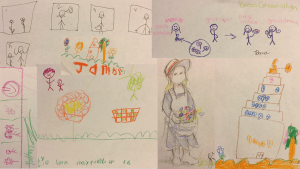 Then I went in. Grandfather met me first.
  (by Mary Elizabeth Losee Olsen, about her grandparents, Andrew and Anna Maria Peterson
 AncestorClips