
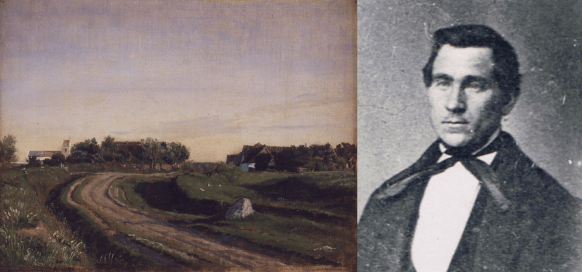
 In 1847, on the north shore of Zealand, as Danish citizens fought for “freedom of press, and religion,”1 fourteen-year old Hans Sorensen finished school and entered apprenticeship. That same year his mother and grandmother died. In 1849 the monarch gave in and the people won their desired freedoms.2 With a feeling of opportunity, Hans studied with a demanding shoemaker, and using local materials he became skilled at constructing shoes and saddles with maple pegs and strong flax thread.1 He was among the “industrious, peaceable, and skillful,”3 of his people. At age 20 his brother and father died4 but he continued his trade and service to his community. Nine years later, he married Maren Kristine Hansdatter also of his Parish and opened a shoe-shop in the nearby town of Tisvilde.1 The 1864 conflict with Prussia and Austria pulled him away from his work and bride as he was drafted in the 2nd battle of Schleswig-Holstein.1 He survived the painful war but Denmark lost significant portions of the country.2 Religious freedom was crossing the country as were the Mormon missionaries. As predicted by a Latter-day Saint leader, the war served to, “awaken the indifferent and the careless to a sense of their situation, and thus [brought] many into the Church…”3 Hans attended a Latter-day Saint meeting, “was impressed with their message… investigated…the doctrine, and was satisfied he had found the Pearl of Great Price.”1 #Ancestorclips
(1) Sorensen, George H, Hans Sorensen, as compiled in Hardman Biographies, Ancestors of Sidney Glenn Hardman and Dorothy Mae Griffin, Dec. 2009
(2) Wikipedia.org
(3) Christensen, Marius A. History of the Danish Mission of the Church of Jesus Christ of Latter-day-Saints, A Thesis, BYU, March 1966
(4) FamilySearch.org (photo of Hans Sorensen, and other information)
(5) Painting from Vejby in Nordsjaelland by Johan Thomas Lundbye, 1843, commons.wikimedia.org
Author Note:
Hans Sorensen is my great-great grandfather. I sense from him a patient, day-by-day determined character who followed his heart even in the face of loss. In his youth, he lost his grand-parents, parents, and a brother. As a new groom, he was taken from his wife for war. As a seeker of truth, he lost his friends and extended family. Yet, the choices later in life demonstrate that he built upon the strong character of his youth. He followed his heart. He worked hard, built a family, and became a blessing to his posterity and his ancestry by his faithfulness to God. Truly he lived the commandment to ‘honor thy father and thy mother’ (Exodus 20:12) including ancestors by the life he lived. As one in his family tree, I can draw from the seeds of patient character and diligence inherited from Hans Sorensen.
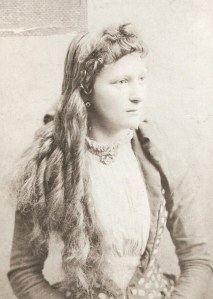 At age 7, my great-grandmother Lillie and her dear 10 year old sister Clara were close, living a happy life together with their hardworking, loving parents and family. “Mother always took pride in our hair,” she wrote. They wore tight braids to bed on Saturday, and went to Sunday School in lovely curls. One day, Lillie learned that Clara would be the first of the family to go to America. Tears prompted her father to borrow money so the two would not be separated. In spring of 1883, they traveled with a missionary from her little village to Liverpool by train, by steamship to America, and by train to Salt Lake City, homesick for family, motherly care, bread and butter (scrape), bread pudding with sugar and raisins, cheese and watercress, and Sunday walks up the green. On arrival they found mosquitoes and a hot rail yard, not streets paved with gold, but they were cared for by their aunts including a hot bath and their hair combed out. Being daughters of shoe makers, they literally stood out, the boys pointing at the “stogies” (stout coarse shoes) on their feet. Lillie was often frightened at night. She learned to sew, attended summer school, and Sunday School. They missed their parents and siblings. A whole year after arrival, word came that father would come, but alone since a new baby required mother, brother and sisters to come later. She missed them all. “One day, Lillie was playing in the kitchen and a large rubber ball with colored pictures rolled across the floor. She looked up to see where it had come from and saw her dear father. She sprang into his arms and tears of gratitude rolled down her cheeks.” (By Kenneth Richard Hardman, adapted from William Wallace & Annie Lillie Clark Walker Book of Remembrance: Their Life, Their Family and Their Story, 1985, compiled by Dorothy Hardman with excerpts from Lillie’s autobiography. Photo from family archives)
 AncestorClips