
 Opportunity was slim in Newton Utah in 1899. Walter and Eliza Caroline journeyed by steam locomotive from Newton to Indian Valley Idaho, anxious for promising, “cheap and plentiful” land further north. A “lawless element…infested the railroad,” so, “mother and the two baby boys rode in a passenger car” while Walter guarded the family’s possessions in a box car. Aroused from the continuous clickety-clack, he heard galloping horses and rough voices outside the train. An instant later, rough fingers wrapped around the end of the box car door. “Get out o’ here,” he yelled. The door opened a few inches with a slow screech. The Griffin “livestock” stirred, “penned-off at one end,” of the car. Their furniture and [belongings] were at the other end, and their heavy “machinery, wagon and food…were…near the doorway.” No stranger to guns and outdoors, he had learned hunting and defense from his frontiersman father. Walter grabbed his Colt .45 from beside his books and lantern. He stood, shoulders back, chin high, and aimed. A “tough” face looked in. Walter pulled back the hammer; the click filled the car. He “tighten[ed] his finger on the trigger.” The intruder “read the message in his eyes,” muttered, then backed out and “dropped off” the train. The family made it safely to Indian Valley, prospered “handsomely” for ten years then returned to Utah due to concern over “raising their family in this relatively untamed country.” Moving from “a prosperous…ranch” in Idaho to a “alkali-infested lake shore [in Utah] brought years of toil and struggle. However, [Walter] tackled it resolutely, often stating that, ‘hard work and perseverance could overcome any obstacle.’” #AncestorClips
Author Note: Not knowing for certain what type of gun Walter owned, the author used the model most popular at the time. A few other details were added without explicit basis including “galloping horses,” “rough fingers,” and “Get out o’ here.” All else is based on the primary reference (1) and related scenarios.
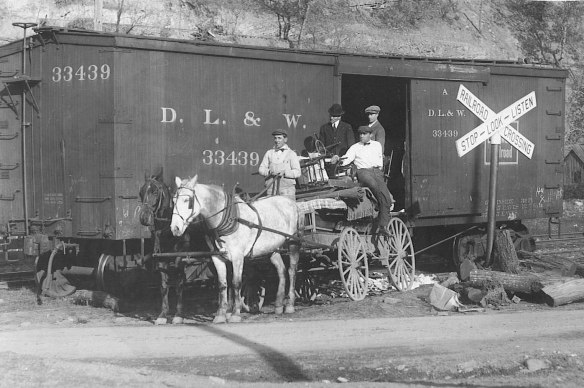
Train Image Caption: Train History, Image of Delaware box car. “A Delaware, Lackawanna and Western Railroadwagon at a level crossing, circa 1900.” (https://en.wikipedia.org/wiki/History_of_rail_transport_in_the_United_States)
References:
- Geraldine G. Griffin, The Family of John Griffin and Ruth Keep, June 1988, adapted from account by Henry LeGrand Griffin (primary reference)
- Revolver, “Although originally made for the United States Army, the Model 1873 was widely distributed and popular with civilians, ranchers, lawmen, and outlaws” (https://en.wikipedia.org/wiki/Revolver)
 My great-grandfather William was 11 when his father died, and the English officers came to take him and his four brothers to the poorhouse. “How we clung to mother’s dress,” he said. Isabella was, a little woman. But in faith and work, [she was] a wonder. “Not one of these boys goes,” she said. “Each and everyone will go to Zion.” William had to quit school to sell papers, sweep crossings, and sell milk door-to-door. He worked in a small store, never touching money left laying around by the manager. “I wouldn’t take anything I did not honestly earn,” he said. No one doubted Williams honesty. Encouraged by his mother’s faith and letters. One by one all 7, plus mother made it to the valleys of the Salt Lake. In Utah and Colorado, at age 16 he maintained railroad ties for the Rio Grande, was promoted to surveyor, track foreman, bridge inspector, and conductor, sending every penny he could to his mother while contributing to the college education of his younger brother. On a work assignment he met Rachel Ault at the Cedar Valley station. They later married and ran a boarding house. Self educated, William spoke as though a scholar, brilliant in mathematics. Knowledgeable men often came to him to solve problems. He was happy, shook hands with everyone, did not find fault, and expected his children to respect others, especially their mother, and would not settle for any kind of sloppy job. He honored people, hung photos of servicemen on his wall, and wrote a poem for each funeral in the community. “And my dear loved ones, Lord I pray, protect, direct and guide each day. Dear Lord in truth may I increase, that when my mortal life shall cease, I may be worthy, Lord, with thee, to serve through all eternity.”
 AncestorClips