
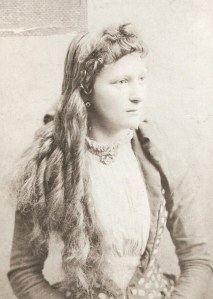
 At age 7, my great-grandmother Lillie and her dear 10 year old sister Clara were close, living a happy life together with their hardworking, loving parents and family. “Mother always took pride in our hair,” she wrote. They wore tight braids to bed on Saturday, and went to Sunday School in lovely curls. One day, Lillie learned that Clara would be the first of the family to go to America. Tears prompted her father to borrow money so the two would not be separated. In spring of 1883, they traveled with a missionary from her little village to Liverpool by train, by steamship to America, and by train to Salt Lake City, homesick for family, motherly care, bread and butter (scrape), bread pudding with sugar and raisins, cheese and watercress, and Sunday walks up the green. On arrival they found mosquitoes and a hot rail yard, not streets paved with gold, but they were cared for by their aunts including a hot bath and their hair combed out. Being daughters of shoe makers, they literally stood out, the boys pointing at the “stogies” (stout coarse shoes) on their feet. Lillie was often frightened at night. She learned to sew, attended summer school, and Sunday School. They missed their parents and siblings. A whole year after arrival, word came that father would come, but alone since a new baby required mother, brother and sisters to come later. She missed them all. “One day, Lillie was playing in the kitchen and a large rubber ball with colored pictures rolled across the floor. She looked up to see where it had come from and saw her dear father. She sprang into his arms and tears of gratitude rolled down her cheeks.” (By Kenneth Richard Hardman, adapted from William Wallace & Annie Lillie Clark Walker Book of Remembrance: Their Life, Their Family and Their Story, 1985, compiled by Dorothy Hardman with excerpts from Lillie’s autobiography. Photo from family archives)
 During World War 1, and the Influenza Epidemic of 1918, sixteen-year-old Ella Mae Walker lay sick in bed for a week. “People died like ants,” she said. Everyone wore masks. “No one seemed to be exempt from the terrible disease.” No one visited. Lot’s of boys were dying abroad, animals were dying from the cold, and people were dying from the disease. Finding strength in prayer, Ella Mae recovered and with her hard working family remained grateful, and went about making soups, bread, and puddings. “Father and I would go in our wagon and take it to the homes.” Ella Mae was allowed to attend the funeral of a childhood friend. It wasn’t always that way; recalling her happy childhood, “The boys all played marbles, and we girls like to run and kick them out of their rings, and were often caught and had our braids pulled good and hard.” During setbacks, “The Lord has always helped me find many little things that just had to be found. I have knelt down by sage brushes or big tumbleweeds many times to ask him for help.” After the war and epidemic, those who remained, like Ella Mae went on, cheerfully, in honor of those who didn’t. Now, almost 100 years later, when I think of the bread pudding my grandma made for me as a child, I remember the goodness of her life, the “little things, the things that just have to be found,” and want to be like her. (by Ken Hardman, Ref. HARDMAN BIOGRAPHIES, Ancestors of Sidney Glenn Hardman and Dorothy Mae Griffin, Dec. 2009) #AncestorClips
 AncestorClips