
 “Hannah gave Andrew to understand that her husband had to be worthy to take her to the temple. So he set about preparing himself…” At last the happy day arrived. He borrowed a team and sleigh and they drove from St. John, Idaho to Logan, Utah. Living near their extended family, “they had good land, flowing wells, excellent horses and fat cattle.” On urgings from “a sharp real estate salesman,” the large group sold-out and went to Canada to start a ranch with their “100 head of cattle and 14 sheep camps.” It was the coldest winter on record and, “they lost most of the herd.” In the spring, with much sorrow and homesickness, Andrew and Hannah returned to Idaho to homestead 160 acres at “the head of the Big Malad River.” The high sagebrush indicated good soil but required “long, tiresome work” to clear the land. In the summer, they lived in a log cabin; in the winter they lived in St. John where their five children attended school. In later years, he broke his ankle and also had a stroke but remained cheerful. Hannah learned to drive when he no longer could. When grandchildren, Ferril and Rex, came to visit, Hannah drove them around town to show them off. Before his death, Andrew said, “It is my advice to all young people to read and learn all they can about this wonderful church we have and never turn down an opportunity to labor in this great work that we as Latter-day Saints have accepted.” Andrew died on his 80th birthday. Hannah said, “We had a happy married life. We never had a quarrel… I am thankful I had such a good man and such good children.”
(By Kenneth R. Hardman, based on Losee, Ferril A., South, Betty, The Anderson and Josephson Family History – Ancestors and Descendants of Lars Anderson and Anna Andersdotter, Lars Charles and Anna Isaacson Josephson, 1999, pages 57-65, photo from same reference) #AncestorClips
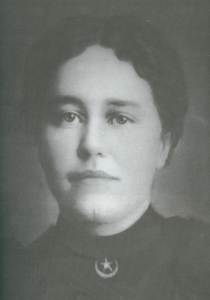 Hannah Elizabeth Josephson, came into the world (St. John, Idaho, to be exact) on November 27, 1877, 2 days before Thanksgiving. She was the 3rd of 12 children born to Lars and Anna Josephson, immigrants from Sweden. There was great love and respect in this large but united family. They were known as “one of the best behaved in the valley.” Hannah was a “pretty brunette,” industrious, and “of a cheerful and religious disposition.” “I used to pray every day and trusted in the Lord,” she said. “I had my prayers answered many times.” The children were taught reading, writing, arithmetic, and geography by their mother, so Hannah was well prepared to enter school at age 6, and continued through the 8th grade. In 1887, nearly all family members including her father had a brush with Typhoid Fever. Three months of dedicated nursing and service by the church and community pulled them through. There were no deaths in the family, but her brother Levi stuttered badly the rest of his life. Hannah was baptized in 1891. She was inspired by her parent’s faith and devotion. “Many times I saw [my father] ride on horseback a distance of 15 miles to attend priesthood meeting. My whole family was religious at heart.” Hannah served as 2nd Counselor in the Young Ladies Mutual Improvement Association at age 18, admired church leaders, and remained active all her days. She too, had many admirers. While courting the man of her choice, “Hannah gave [him] to understand that her husband had to be worthy to take her to the temple.”
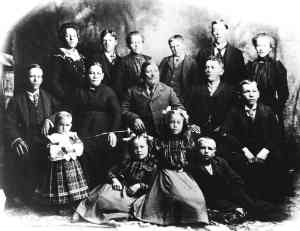 Lars Josephson came by train…to Brigham City. There he worked on the railroad…then drifted northward and took up a 160-acre farm at St. John, Idaho…He got a job in Star and Marsh valleys to pay for a yoke of black oxen…Crossing the Bear River, one of the oxen got stuck in quick sand and they were unable to save him, so he had to work some more…He married Anna Isaacson in 1871 in Salt Lake City in the Endowment House. They…had 12 children: 4 girls and 8 boys. He was quite a religious man and [rode] 15 miles to Portage to Priesthood meetings and went to Malad to conferences…They dug an 80-foot well and drew the water up in buckets. He was a shoemaker…and made all the…harnesses they used–also mended shoes for the neighbors. He helped build 2 reservoirs and had good water rights for his farm. His home, barns and sheds were all made of logs which he hauled…by ox team…He had to haul his crops long distances to Corrine to the railroad…very long cold trips of two and three days and they had to sleep by a campfire in all kinds of weather…They always had plenty of flour, cured meats, honey, fruits, and vegetables and large cheeses. He was generous and shared much with his neighbors…[On] December 2, 1902, their home burned to the ground. They saved a few things and the people turned out and helped build a two-roomed log house in a short time with some logs Charles had there. They lived in a tent until the house was finished…He was of normal temperament and seemed to have a good understanding of the gospel. He had a lot of friends, and his family was well behaved. He loved his horses and drove them on a trot and sang as he went.”
 I have been reading biographies and autobiographies about my wife’s ancestors,
  AncestorClips