

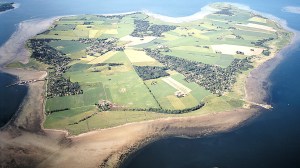
Young Jens felt alone on the Oro Isle;
alone as a boy could be.
His mother and brother were taken in death,
his father was gone, so you see
His grandmother’s sister took him into her fold,
but the fold was too cold for his care.
He attended the school, he attended the church,
he bided his time while there.
From the shores of his island he could see cross the fjord
through the mouth to the north of the bay.
The island grew smaller as the tide rolled in,
as he sat on the shore each day
Then when old enough to be his own man,
he set out to follow his dream.
A sailor he made in the navy of Dane
turning tide on the life that had been.
On ship he was agile, trustworthy and strong;
he climbed the rope latter and mast,
Unfurling the sails, catching wind round the world,
turning tide on his difficult past.
One day with the wind in his light brown hair,
he returned from the open sea;
and cast his blue eyes on a beautiful sight.
and married sweet Else Marie.
(by Ken Hardman based on the following references) #AncestorClips
References:
(1) Hansen, Ray, Jens Hansen, as given in The Hansen & Gulbrandsen Family History, compiled by Jana Greenhalgh, Dona Losee, and Ray Hansen
(2) Hansen, Shannan, Denmark to Zion: The Immigration of Jens and Else Hansen, 29 Nov. 2000
(3) Photo of Oro island from google.com
Authors comment: Is life unfair? Are you always at the bottom, looking up? Jens Hansen is a great-grandfather of my wife, Joan Losee Hardman. I find strength in his example of moving from limited opportunity to great potential. I picture him in a lowly church pew looking upward to God, from a small island in the Isel fjord to the wide open seas as a seaman, from the decks of clipper ships to the heights of their derricks unfurling sails to unveil the horizons, and on and on upward to the potential of God’s plan for him as evidenced by the rest of his history. I’m pleased that my children and grand-children can look up to their ancestor, Jens Hansen as one who positively Turned the Tide.
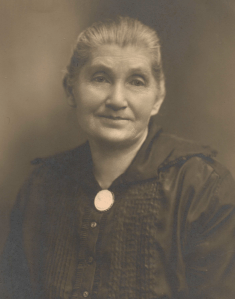 Anne Marie gasped as her knees buckled. She sat down immediately on the rough porch covering her mouth with one clinched hand, holding her chest with the other. She widened her beautiful gray eyes to prevent tears from falling, which eventually spilled to the ground. She had married in Denmark, leaving her “quaint Danish home…dirt floor and thatched roof,” and set sail with her new born child promising to work hard and send money so her husband could join them in America. Her mother and brother had immigrated earlier and by their toil had saved and sent enough for Anne Marie to come. “She crossed the North Sea,” where she and the child suffered terrible sea sickness. Now in Richfield, Utah, “she scrubbed floors and cleaned to…take care of her little son. When she had saved enough…, she sent it to her husband…so he could join them…” But that was not to be. ‘Tell me again what he said,’ she asked. “During the voyage [to New York,] he heard so many derogatory things about the Mormons, and about the Indians killing people in the west, and he got frightened. When he arrived…he turned around and went back to Denmark.” More tears fell from her eyes. She never heard from her husband again. A few years later her child died of typhoid fever. Even so, she retained here kindness and faithfulness as a member of the church. She married again, had seven children and cared for several more. Her youngest child, Harvey, later said, “My mother was a wonderful person…she just couldn’t see anything bad about anyone…my parents never had anything…they gave it all away…we had a happy home…she just loved everybody and everybody loved her…”
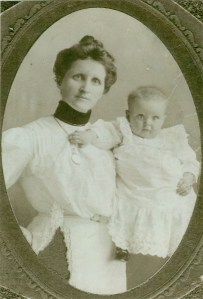 “In the spring of 1908, Dad was called on a mission to Norway. Mother and five children were left home. In the spring of 1909, Edna was stricken with pneumonia, so the doctors thought. It later was diagnosed as spinal meningitis. One cold wintry night, Mrs. Williams, a neighbor, came over to help mother as Edna was so ill. It was almost midnight when Mrs. Williams said, ‘I am afraid she is gone.’ Mother put her head under the mattress and cried ‘No Dear God, no!’ I had been taught about prayer and about the elders of the Church. So I ran a half a block up the street to Bro. George R. Emery with bare feet and snow up to my knees, and asked if he would come and bless my sister. He put his coat over his long night shirt and carried me home. As he put his hands on Edna’s head and started to pray, I stood by and watched her little white face so still. All of a sudden, little red streaks started up from her mouth and then a gasp. She relaxed into a sleep for the first time in weeks. This was my first testimony and answer to prayer and I knew God heard and answered prayers … Edna was always very precious to me from then on. My interests were always for her.”
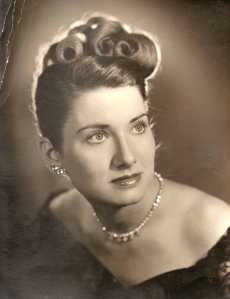 During the boom-town 1950s in Los Angeles, Dona Hansen, the queen of the church Gold and Green Ball, and daughter of a self educated businessman and a most charitable mother, culminated her youth in what she thought would be the crowning event, marriage to a promising man. A short time later while anticipating their first born, her husband left her. She was devastated. “I didn’t think anyone would want to marry a divorced woman with a little son,” she thought. Dona prayed as she always did, was blessed by the prayers of others, and remained “close to [her] Father in Heaven and Savior.” Some time later Dona received a proposal of marriage from a man not of her faith, and she went away to Salt Lake City to consider her future seeking direction in the Temple. She felt inspired to return to Los Angeles. Upon her return, she felt and knew that he was not the one. To her surprise, her fiancé informed her, “I have just met a fellow at church. In fact, he is just what you are looking for.” Driven by the Spirit of the Lord, she stood in church and bore her testimony. Her fiancé and friend Ferril Losee were in attendance. Ferril thought, “She is wonderful but… to good for me.” A short time later, noting the absence of the ring, Ferril asked Dona out on a date. They drove to the beach where, as the sun set upon a beautiful day, the sun rose on a glorious union. Ferril said that he “would be the happiest man on earth if [Dona] would consent to marry him.” Dona knew the Lord was in it, and agreed. (by Kenneth Hardman, adapted from, Losee, Ferril A.,
  In the 1940s, during the boom-town years in Los Angeles, Harvey Ralph Hansen became a highly successful grocery businessman, first with Safeway, then on his own, feeding the ever-growing population of World War II factory workers flooding in from the east. Harvey grew up on the farm in Richfield, Utah, married the sweet city girl Edna Violet Gulbrandsen, raised two children, and ran his businesses and investments. The stress however, took its toll. In his forties, Harvey had a heart attack and thought he would die. Treatment was successful but he needed to reduce his stress and work. They moved to Fallbrook, California, purchased an avocado ranch and worked the land, nourished the fruit and nurtured himself back to health. He had a great desire to learn and to serve. He read the entire Encyclopedia Britannica, built and ran a convalescent home, served as an ecclesiastical leader, listened and read continuously from apostles and prophets and was firm in his faith. Harvey Ralph Hansen was my grandfather. Since my own heart attack, knowing what he went through gives me hope that my future experiences and choices will be fruitful, as were his. (by Joan Hardman, photo from family archives) #AncestorClips
 AncestorClips