Dear friends, I’d like your vote. I wrote a song for the Rootstech 2021 Song Contest (Amateur category) about my ancestor, John Griffin. Since I love family history, and music, this was an opportunity to combine both, and share what I’ve gained from this great man. Please click the rootstech link below, listen to “Ballad of John Griffin,” click, Vote For This Song, then share this link with friends and family. Thanks for the favor. Link Thanks sincerely,Ken Hardman
The fog settled over the immigrant ship American Congress off the shores of Newfoundland. The sun did not shine, nor provide navigational reference for the crew. James Keep and his wife Ann, three daughters, and one grand-baby were sailing for Zion with 350 Saints. While on deck, James looked forward for a time, then aft, reflecting on the hopeful journey yet ahead, and then on his life back in England. He was five years old when his father died, was raised a few more years by family members, but mostly, with little schooling, made his own way keeping sheep, cows, horses, or any work he could find. The heavy fog bore down a second day on the ship. James thought back on his apprenticeship as a brick layer and his nine years with his first wife Elizabeth. Sometime after her death, James married Ann Miller, and he began to seek religion. He attended the Wesleyan’s, and later the Baptist’s, and then the Independent’s, each for a number of years, but still felt alone. “I could never tell what the Kingdom of God was,” he wrote. The thick fog prevailed a third day; their location and direction, unknown. James recalled the two young men who brought the restored gospel to his home. Encouraged by his wife, he listened. “I never knew what God was until I came into this church.” He and his family were baptized and accepted callings. He traveled extensively to preach the gospel for twenty years. Now at age 60, on a ship in the Atlantic, Johns faith in God’s promises held strong. “Captain,” a man yelled, “what is that?” The man on the quarter deck pointed anxiously forward. The fog [had] lifted from the surface of the sea, as if a veil or scroll had been raised. The tall powerful captain looked, then sprang to the wheelhouse like a tiger, knocked the helmsman down, grabbed the wheel, and with full presence of mind and moment, turned it about. Sailors sprang to their posts at his commands, as the ship swayed and turned avoiding rocks, breakers, and a watery grave. Many thanks were given to God for lifting the fog, and protecting the saints.
(by Kenneth R. Hardman, based on accounts in Hardman Biographies – Ancestors of Sidney Glenn Hardman and Dorothy Mae Griffin, personal writings of James Joseph Keep, writings of Sarah Keep Buttars, and account Saved by Providence by J. Nicholson) #AncestorClips
Glenn performed his military duties and was absolutely determined to be an example and a Christian. He never served as a formal missionary for The Church of Jesus Christ of Latter-day Saints, but he took every opportunity to act like one. “There is a fellow in the company that is a member of the church, but not very active. He has promised me that he will go to church, but as yet, he hasn’t. He got quite drunk and started to lose his money, so what does old dad do? I stepped in. He was gambling, so I took his money and his wallet away from him, and… finally got him in bed, but he wouldn’t stay there, so we took him down and put him in the ice-cold shower. Believe me, that really straightened him out in a hurry. I hate to get mixed up with anything like that, but we do have to take care of our brothers, don’t we?” While in the service, he held a number of things close to his heart including letters from home, church magazines, a portrait of Dorothy, and a little photo of his parents and sister. To his wife back home he spoke of blessings on Earth and in Heaven, “If we only live our religion as we have been taught, we shall have these things and also reach eternal life…It will really be a wonderful day when we can both stand together and thank our Father in Heaven for all His blessings.” This is who they were and who they are. This is who I want to be.
(by Kenneth R. Hardman with excerpts from, “Sidney Glenn Hardman and Dorothy Mae Griffin – Their story and their life,” Volume 1, 1928 – 1952) #AncestorClips
Glenn Hardman and Dorothy Griffin; did they become good independent of outside factors? Certainly, not. Did any of this goodness come from their parents and ancestry? Certainly, yes. Dorothy spoke of her childhood. “I am truly grateful that my parents were always active and that they taught us by their example that church was the place we were to go, that activity in the church would bring joy and satisfaction to our lives. Though I have no memory of a burning testimony in those days, I know the seeds were planted then for my love of the church as I have grown older.” Similarly, Dorothy wrote of Glenn, “He went to Primary and learned about courage and being pure in heart, to be a cheerful helper to his father and mother every day, to say thank you, to obey, to be courteous at home, school and Primary, to pray and to appreciate the beautiful world.” As Glenn and Dorothy continued to grow in their youth, they made choices that brought them in contact with additional sources of help and divine instruction. While a young adult, Dorothy received an assignment she thought miraculous that gave her opportunity to serve in new ways, making her realize the source of her talents, and how she could use them for much good. “I began to see,” she wrote, “what the patriarch had meant when he told me I had talents that would manifest themselves in the positions of responsibility which I would have…” Glenn demonstrated his integrity when on his own in California, surrounded by a world of opportunities for good and bad. In a letter to his parents back home, some trusted friends wrote, “He never misses a day without coming in and reporting in. He is only going with church boys and girls and taking in the church activities. Dorothy Griffin, the girl he takes most, is a swell Mormon girl.” I can see how my life was and is influenced by their lives… I can see their influence in my life, in the lives of all their children, and their grandchildren and their great-grandchildren.
(Excerpts from Forward of, “Sidney Glenn Hardman and Dorothy Mae Griffin – Their story and their life,” Volume 1, 1928 – 1952, by Dorothy Hardman. Forward by Kenneth R. Hardman in 2015 compilation) #AncestorClips
As the smoke of the industrial revolution continuously settled on residents of Manchester England, in 1834, death persistently came to rest on the small home of Margaret and Richard Hardman. Likely with broken heart wondering if she would ever have children, she laid her fifth lifeless baby to rest in an early tiny grave. Margaret was a weaver, Richard was a rope-maker, but another 9 hopeful months passed with no daughters for mom to dress, and no sons to enter dad’s trade. With prayer, work, endurance, and love, another 10 years passed and 6 more pregnancies. Three would die, but three lived on; Alice Eliza, Lehi Nephi, and George Richard. Alice received the middle name of her grandmother, Elizabeth; George bore the middle name of his father, Richard; and Lehi Nephi carried the names given him by a prophet a year before he was born. Poor health restored under Priesthood hands by the Gospel of the Restoration, Margaret and Richard carried on, gathered with the Latter-day Saints, moved from their home with many of their family, ever onward, following the prophets from Manchester to Nauvoo. Living only blocks from the Nauvoo temple, they built Nauvoo, the Temple, and their posterity. After their eternal marriage and sealing in the Temple of God, Margaret lost Richard, missing on the Mississippi while working and escorting family members to Zion. Widowed, cast out through trails of sorrow, Illinois, Missouri, Iowa, Nebraska, and the loss of her second husband William Presley to cholera, she pressed onward, eventually to a place where her children including Jane Amanda Presley met their companions, raised righteous families, and gave Margaret posterity beyond all that she could have imagined. We too, can press onward, ever onward. #AncestorClips
Author Notes: My heart is broken for Margaret and Richard, broken along the extremes of the emotional spectrum, alternating between depths of anguish and heights of admiration. Margaret came from a large family where she helped raise many of her younger siblings. Imagine the heart break as each of five, 9-month pregnancies ended in death. Did they wonder if life was worth it? Did they get angry with God? Did she want to give up when other children died, or when she lost her health or her husband? When I pass through the veil of death some day, I expect to meet her and ask these questions. But when I do, it won’t be to confirm her pain for I’m certain it was bitter. No, my desire to meet her and talk to her will be because of the great honor I hold for her. She certainly would have had her days of trial, but her life in totality reveals faith, prayer, spiritual sensitivity, and determination, ever onward. She raised good children, had faith to be healed, listened to her heart, united with her husband, followed prophets, had vision to see past mortality to eternity with a large posterity, with the blessings she frequently desired. Thank you Margaret and Richard for never giving up. Thank you for believing; believing in yourselves, believing in God, and believing in me and the multitudes whose veins carry your blood and your blessings.
Halvor Halvorsen was a ship captain sailing in and out of the fjords, up and down the beautiful Norway western seaboard. [His wife and children lived in the north in Namsos] As his family grew [to 8 children], he longed to be with them, acquired a telegraph station in northern Norway, where he could work on land, and have his family with him, but he took seriously ill in the north, and died. Before his death, in a touching letter to his family he wrote his memories about his parents and siblings, and then these heart felt words to his children.
“And now, I am leaving you all to God. May He put his protecting hand around us, and guide us to the place that He has set aside for us. Let no one ever threaten or persuade you to go against your conscience, for this will sooner or later come back to you with added interest. Think of your father, and remember, that if any of you should commit any kind of a crime, I will be watching you, and so will our Heavenly Father who had everything recorded that you have done in this world. Be kind and helpful to each other and to your mother, for all your happiness in this world will depend on this. Let the bigger ones help the smaller ones, and do not forget that you are all your father’s children, and it would hurt me deeply on the other side of the grave, if any of my children should leave their God, and start going in the wrong road. Be aware of these things, dear children, and protect the memory of your father, who never was able to commit anything real bad or evil, But I am deeply sorry to say that I have all to often sinned against my God and His commandments. This I must, in all humility, ask God to forgive me in His unending grace, Amen. This is my will to you, I have no money to leave you. I received little or nothing myself. But if you will do what is right, you will have riches enough, believe you me. All happiness and joy in this world does not depend on money, and even much less after death. Do not be hypocrites, give your opinion honest and frankly to everyone. This will not make you rich. But I have always felt a contempt for these creeping beings, and they are to be looked down upon, as far as I have any knowledge of the world.”
(by Kenneth Hardman, 2018, based on “Our Gulbrandsen Ancestry,” by Jana Greenhalgh, and the ‘Will’ of Halvor Halvorsen in, “The Hansen and Gulbrandsen Family History – Ancestors & Descendants of Edna Violet Gulbrandsen & Harvey Ralph Hansen,” compiled by: Jana Greenhalgh, Dona Losee, Ray Hansen) #AncestorClips
In 1847, on the north shore of Zealand, as Danish citizens fought for “freedom of press, and religion,”1 fourteen-year old Hans Sorensen finished school and entered apprenticeship. That same year his mother and grandmother died. In 1849 the monarch gave in and the people won their desired freedoms.2 With a feeling of opportunity, Hans studied with a demanding shoemaker, and using local materials he became skilled at constructing shoes and saddles with maple pegs and strong flax thread.1 He was among the “industrious, peaceable, and skillful,”3 of his people. At age 20 his brother and father died4 but he continued his trade and service to his community. Nine years later, he married Maren Kristine Hansdatter also of his Parish and opened a shoe-shop in the nearby town of Tisvilde.1 The 1864 conflict with Prussia and Austria pulled him away from his work and bride as he was drafted in the 2nd battle of Schleswig-Holstein.1 He survived the painful war but Denmark lost significant portions of the country.2 Religious freedom was crossing the country as were the Mormon missionaries. As predicted by a Latter-day Saint leader, the war served to, “awaken the indifferent and the careless to a sense of their situation, and thus [brought] many into the Church…”3 Hans attended a Latter-day Saint meeting, “was impressed with their message… investigated…the doctrine, and was satisfied he had found the Pearl of Great Price.”1 #Ancestorclips
(1) Sorensen, George H, Hans Sorensen, as compiled in Hardman Biographies, Ancestors of Sidney Glenn Hardman and Dorothy Mae Griffin, Dec. 2009
(2) Wikipedia.org
(3) Christensen, Marius A. History of the Danish Mission of the Church of Jesus Christ of Latter-day-Saints, A Thesis, BYU, March 1966
(4) FamilySearch.org (photo of Hans Sorensen, and other information)
(5) Painting from Vejby in Nordsjaelland by Johan Thomas Lundbye, 1843, commons.wikimedia.org
Author Note:
Hans Sorensen is my great-great grandfather. I sense from him a patient, day-by-day determined character who followed his heart even in the face of loss. In his youth, he lost his grand-parents, parents, and a brother. As a new groom, he was taken from his wife for war. As a seeker of truth, he lost his friends and extended family. Yet, the choices later in life demonstrate that he built upon the strong character of his youth. He followed his heart. He worked hard, built a family, and became a blessing to his posterity and his ancestry by his faithfulness to God. Truly he lived the commandment to ‘honor thy father and thy mother’ (Exodus 20:12) including ancestors by the life he lived. As one in his family tree, I can draw from the seeds of patient character and diligence inherited from Hans Sorensen.
Young Jens felt alone on the Oro Isle;
alone as a boy could be.
His mother and brother were taken in death,
his father was gone, so you see
His grandmother’s sister took him into her fold,
but the fold was too cold for his care.
He attended the school, he attended the church,
he bided his time while there.
From the shores of his island he could see cross the fjord
through the mouth to the north of the bay.
The island grew smaller as the tide rolled in,
as he sat on the shore each day
Then when old enough to be his own man,
he set out to follow his dream.
A sailor he made in the navy of Dane
turning tide on the life that had been.
On ship he was agile, trustworthy and strong;
he climbed the rope latter and mast,
Unfurling the sails, catching wind round the world,
turning tide on his difficult past.
One day with the wind in his light brown hair,
he returned from the open sea;
and cast his blue eyes on a beautiful sight.
and married sweet Else Marie.
(by Ken Hardman based on the following references) #AncestorClips
References:
(1) Hansen, Ray, Jens Hansen, as given in The Hansen & Gulbrandsen Family History, compiled by Jana Greenhalgh, Dona Losee, and Ray Hansen
(2) Hansen, Shannan, Denmark to Zion: The Immigration of Jens and Else Hansen, 29 Nov. 2000
(3) Photo of Oro island from google.com
Authors comment: Is life unfair? Are you always at the bottom, looking up? Jens Hansen is a great-grandfather of my wife, Joan Losee Hardman. I find strength in his example of moving from limited opportunity to great potential. I picture him in a lowly church pew looking upward to God, from a small island in the Isel fjord to the wide open seas as a seaman, from the decks of clipper ships to the heights of their derricks unfurling sails to unveil the horizons, and on and on upward to the potential of God’s plan for him as evidenced by the rest of his history. I’m pleased that my children and grand-children can look up to their ancestor, Jens Hansen as one who positively Turned the Tide.
Andrew Peterson was surely heartbroken when his sister Johanna was thrown from a buggy, her dress caught in the wheel, and dragged to death. A heckling mob had frightened the horse, persecutors of the Denmark Mormons. Instead of giving up, the spirit of truth urged Andrew on, he taught the Gospel for a number of years. Then in faith he accepted a mission call to his home country of Sweden where he met and taught widow Greta Pherson and her daughter Anna Maria. Like Andrew, Anna Maria felt the truth, embraced the covenant of baptism and joined Andrew and his family for immigration to America following his release. They travelled from Copenhagen to the major seaport Hamburg and boarded the ship Athena with the saints. Before heading to the North Sea on the river Elbe, the captain needed more room for passengers. He learned that there were six couples engaged to be married. Calling them together he told them he had the authority to marry them and if they would allow this he would have the cooks prepare wedding cakes for each couple and all they could hope for in a wedding dinner. This way he would have six extra beds. Each couple chose to marry including Andrew and Anna Maria. They travelled by sea, rail, and wagon finally settling in Lehi Utah, true to their faith and advocates for Scandinavian saints that would follow.
Video Song – Before the Wind
Written by: Joan (Losee) Hardman (2nd great-grand-daughter of Andrew and Anna)
Music: based on the Wexford Carol
Lyrics:
In a home far away in Swedish land, the Book of Mormon was placed into my hand.
As the pages were read, I felt in my heart, a sweet assurance and a brand new start.
The scorn of the men was readily near. My sisters life taken, a result of their jeers.
Though painful the trials, I felt His hand, and served a mission in my native land.
So before the wind, we set sail on the sea, crossing over the ocean e’er on bended knee.
We ask of the Lord, Ne’er leave us alone, On Zion’s journey to our new mountain home.
The elder who once brought us the truth, became my sweetheart, the love of my youth.
We sold all we had, for a handful of coins, in eternal marriage some day we would join.
On a crowded ship our captain said, If I wed you this evening, there’ll be one extra bed.
So marry we did, and hand in hand, we faced together a foreign land.
So before the wind, we set sail on the sea, crossing over the ocean e’er on bended knee.
We ask of the Lord, Ne’er leave us alone, on Zion’s journey to our new mountain home.
Nine-year-old Edna ran through the orchard with her straight brown hair flapping in the summer air. “Hey Myrtle!” She called back to her ten-year-old sister. “Watch this.” Edna jumped on to a pig, patted his side, and held on. “We’re supposed to be feeding them,” Myrtle pretended to object. “not riding them.” Myrtle looked back toward the house, then dropped her apple bag and with bouncing curls chased down another pig. Both girls laughed, squealed, and finally fell on the orchard grass, giggling, trying to keep their hair out of the rotting summer apples. ‘Emily Myrtle’ and ‘Edna’ Elton were the youngest of eight. The children were taught to be honest, to mind, and to respect and care for others. For chores they packed wood and coal, gathered grain, hauled hay, white-washed walls, pressed apples, thinned beets, and herded sheep. They found fun in many chores as they wove plant stems into chains, made up songs, played school, and ate lunch in the fields with dad. In the winter they rode sleigh, fashioned snowmen, and laid on their backs making snow fairies. Christmas gifts were few, but given with love, then cherished. On Sunday they had a bath in a number three metal tub and wore their treasured Summer dress to church. Forever young and beautiful on the outside, they were playful, loving, and devoted on the inside. Myrtle and Edna loved life, not wishing for things they didn’t have. Their simple dreams fed their imaginations and added spice to their lives and all who knew them.
(by Kenneth R. Hardman. Ref. Sidney Lehi Hardman & Myrtle Emily Elton: Their Life, Their Love and Their Family, 1900-1991 compiled by Dorothy Hardman) #AncestorClips
Inherited traits – Myrtle Elton Hardman is my grandmother. In this story, I can see the influence grandma had on her son, my father who has many of her qualities. Dad often said, “When we work, we work hard; and when we play, we play hard.” I also inherited this tendency. When I work, I put my heart into it; and when I play, I strive to make it fun, as do my siblings. I notice that Myrtle and Edna often combined work and play, finding fun in the labor. Like them, when I am working, I look for joy or satisfaction in the task.
Patterns for my life – There are a few more things I can learn from grandma, and her sister, Edna. In the story, I feel devotion, a sense of companionship beyond friendship. In my life, I can be more devoted in my relationships, especially with family members. Also, even though life was hard back then (from my present perspective), grandma seemed satisfied with what she had, found joy in the moment, and didn’t expect more of what the world might offer. I too can exercise more focus on my present blessings with less envy for what I could have. With more devotion and contentment, I will be happier, like grandma. Thanks Myrtle and Edna for helping me build a happy and useful life.


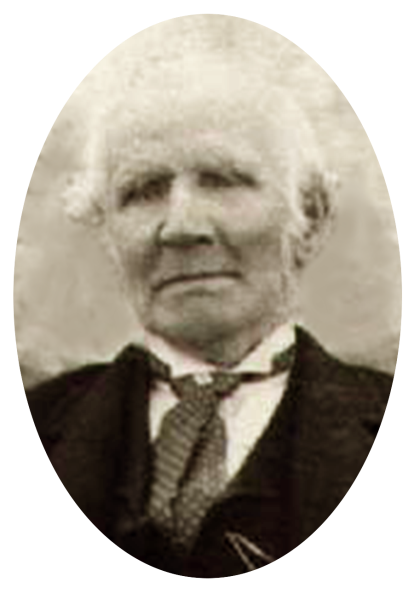 The fog settled over the immigrant ship American Congress off the shores of Newfoundland. The sun did not shine, nor provide navigational reference for the crew. James Keep and his wife Ann, three daughters, and one grand-baby were sailing for Zion with 350 Saints. While on deck, James looked forward for a time, then aft, reflecting on the hopeful journey yet ahead, and then on his life back in England. He was five years old when his father died, was raised a few more years by family members, but mostly, with little schooling, made his own way keeping sheep, cows, horses, or any work he could find. The heavy fog bore down a second day on the ship. James thought back on his apprenticeship as a brick layer and his nine years with his first wife Elizabeth. Sometime after her death, James married Ann Miller, and he began to seek religion. He attended the Wesleyan’s, and later the Baptist’s, and then the Independent’s, each for a number of years, but still felt alone. “I could never tell what the Kingdom of God was,” he wrote. The thick fog prevailed a third day; their location and direction, unknown. James recalled the two young men who brought the restored gospel to his home. Encouraged by his wife, he listened. “I never knew what God was until I came into this church.” He and his family were baptized and accepted callings. He traveled extensively to preach the gospel for twenty years. Now at age 60, on a ship in the Atlantic, Johns faith in God’s promises held strong. “Captain,” a man yelled, “what is that?” The man on the quarter deck pointed anxiously forward. The fog [had] lifted from the surface of the sea, as if a veil or scroll had been raised. The tall powerful captain looked, then sprang to the wheelhouse like a tiger, knocked the helmsman down, grabbed the wheel, and with full presence of mind and moment, turned it about. Sailors sprang to their posts at his commands, as the ship swayed and turned avoiding rocks, breakers, and a watery grave. Many thanks were given to God for lifting the fog, and protecting the saints.
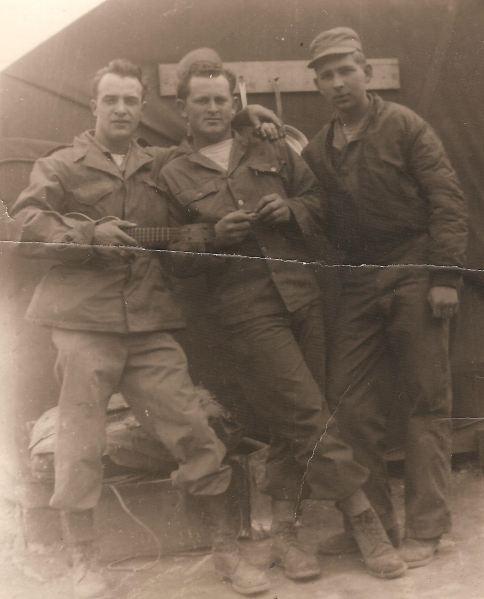 Glenn performed his military duties and was absolutely determined to be an example and a Christian. He never served as a formal missionary for The Church of Jesus Christ of Latter-day Saints, but he took every opportunity to act like one. “There is a fellow in the company that is a member of the church, but not very active. He has promised me that he will go to church, but as yet, he hasn’t. He got quite drunk and started to lose his money, so what does old dad do? I stepped in. He was gambling, so I took his money and his wallet away from him, and… finally got him in bed, but he wouldn’t stay there, so we took him down and put him in the ice-cold shower. Believe me, that really straightened him out in a hurry. I hate to get mixed up with anything like that, but we do have to take care of our brothers, don’t we?” While in the service, he held a number of things close to his heart including letters from home, church magazines, a portrait of Dorothy, and a little photo of his parents and sister. To his wife back home he spoke of blessings on Earth and in Heaven, “If we only live our religion as we have been taught, we shall have these things and also reach eternal life…It will really be a wonderful day when we can both stand together and thank our Father in Heaven for all His blessings.” This is who they were and who they are. This is who I want to be.
 Glenn Hardman and Dorothy Griffin; did they become good independent of outside factors? Certainly, not. Did any of this goodness come from their parents and ancestry? Certainly, yes. Dorothy spoke of her childhood. “I am truly grateful that my parents were always active and that they taught us by their example that church was the place we were to go, that activity in the church would bring joy and satisfaction to our lives. Though I have no memory of a burning testimony in those days, I know the seeds were planted then for my love of the church as I have grown older.” Similarly, Dorothy wrote of Glenn, “He went to Primary and learned about courage and being pure in heart, to be a cheerful helper to his father and mother every day, to say thank you, to obey, to be courteous at home, school and Primary, to pray and to appreciate the beautiful world.” As Glenn and Dorothy continued to grow in their youth, they made choices that brought them in contact with additional sources of help and divine instruction. While a young adult, Dorothy received an assignment she thought miraculous that gave her opportunity to serve in new ways, making her realize the source of her talents, and how she could use them for much good. “I began to see,” she wrote, “what the patriarch had meant when he told me I had talents that would manifest themselves in the positions of responsibility which I would have…” Glenn demonstrated his integrity when on his own in California, surrounded by a world of opportunities for good and bad. In a letter to his parents back home, some trusted friends wrote, “He never misses a day without coming in and reporting in. He is only going with church boys and girls and taking in the church activities. Dorothy Griffin, the girl he takes most, is a swell Mormon girl.” I can see how my life was and is influenced by their lives… I can see their influence in my life, in the lives of all their children, and their grandchildren and their great-grandchildren.
 As the smoke of the industrial revolution continuously settled on residents of Manchester England, in 1834, death persistently came to rest on the small home of Margaret and Richard Hardman. Likely with broken heart wondering if she would ever have children, she laid her fifth lifeless baby to rest in an early tiny grave. Margaret was a weaver, Richard was a rope-maker, but another 9 hopeful months passed with no daughters for mom to dress, and no sons to enter dad’s trade. With prayer, work, endurance, and love, another 10 years passed and 6 more pregnancies. Three would die, but three lived on; Alice Eliza, Lehi Nephi, and George Richard. Alice received the middle name of her grandmother, Elizabeth; George bore the middle name of his father, Richard; and Lehi Nephi carried the names given him by a prophet a year before he was born. Poor health restored under Priesthood hands by the Gospel of the Restoration, Margaret and Richard carried on, gathered with the Latter-day Saints, moved from their home with many of their family, ever onward, following the prophets from Manchester to Nauvoo. Living only blocks from the Nauvoo temple, they built Nauvoo, the Temple, and their posterity. After their eternal marriage and sealing in the Temple of God, Margaret lost Richard, missing on the Mississippi while working and escorting family members to Zion. Widowed, cast out through trails of sorrow, Illinois, Missouri, Iowa, Nebraska, and the loss of her second husband William Presley to cholera, she pressed onward, eventually to a place where her children including Jane Amanda Presley met their companions, raised righteous families, and gave Margaret posterity beyond all that she could have imagined. We too, can press onward, ever onward. #AncestorClips
 Halvor Halvorsen was a ship captain sailing in and out of the fjords, up and down the beautiful Norway western seaboard. [His wife and children lived in the north in Namsos] As his family grew [to 8 children], he longed to be with them, acquired a telegraph station in northern Norway, where he could work on land, and have his family with him, but he took seriously ill in the north, and died. Before his death, in a touching letter to his family he wrote his memories about his parents and siblings, and then these heart felt words to his children.
 In 1847, on the north shore of Zealand, as Danish citizens fought for “freedom of press, and religion,”1 fourteen-year old Hans Sorensen finished school and entered apprenticeship. That same year his mother and grandmother died. In 1849 the monarch gave in and the people won their desired freedoms.2 With a feeling of opportunity, Hans studied with a demanding shoemaker, and using local materials he became skilled at constructing shoes and saddles with maple pegs and strong flax thread.1 He was among the “industrious, peaceable, and skillful,”3 of his people. At age 20 his brother and father died4 but he continued his trade and service to his community. Nine years later, he married Maren Kristine Hansdatter also of his Parish and opened a shoe-shop in the nearby town of Tisvilde.1 The 1864 conflict with Prussia and Austria pulled him away from his work and bride as he was drafted in the 2nd battle of Schleswig-Holstein.1 He survived the painful war but Denmark lost significant portions of the country.2 Religious freedom was crossing the country as were the Mormon missionaries. As predicted by a Latter-day Saint leader, the war served to, “awaken the indifferent and the careless to a sense of their situation, and thus [brought] many into the Church…”3 Hans attended a Latter-day Saint meeting, “was impressed with their message… investigated…the doctrine, and was satisfied he had found the Pearl of Great Price.”1 #Ancestorclips

 Andrew Peterson was surely heartbroken when his sister Johanna was thrown from a buggy, her dress caught in the wheel, and dragged to death. A heckling mob had frightened the horse, persecutors of the Denmark Mormons. Instead of giving up, the spirit of truth urged Andrew on, he taught the Gospel for a number of years. Then in faith he accepted a mission call to his home country of Sweden where he met and taught widow Greta Pherson and her daughter Anna Maria. Like Andrew, Anna Maria felt the truth, embraced the covenant of baptism and joined Andrew and his family for immigration to America following his release. They travelled from Copenhagen to the major seaport Hamburg and boarded the ship Athena with the saints. Before heading to the North Sea on the river Elbe, the captain needed more room for passengers. He learned that there were six couples engaged to be married. Calling them together he told them he had the authority to marry them and if they would allow this he would have the cooks prepare wedding cakes for each couple and all they could hope for in a wedding dinner. This way he would have six extra beds. Each couple chose to marry including Andrew and Anna Maria. They travelled by sea, rail, and wagon finally settling in Lehi Utah, true to their faith and advocates for Scandinavian saints that would follow.
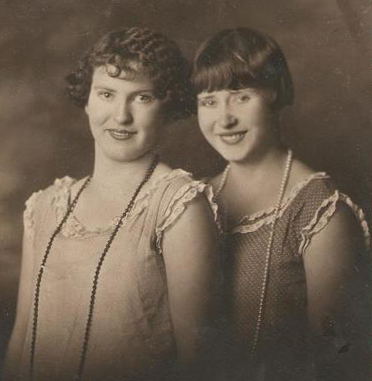 Nine-year-old Edna ran through the orchard with her straight brown hair flapping in the summer air. “Hey Myrtle!” She called back to her ten-year-old sister. “Watch this.” Edna jumped on to a pig, patted his side, and held on. “We’re supposed to be feeding them,” Myrtle pretended to object. “not riding them.” Myrtle looked back toward the house, then dropped her apple bag and with bouncing curls chased down another pig. Both girls laughed, squealed, and finally fell on the orchard grass, giggling, trying to keep their hair out of the rotting summer apples. ‘Emily Myrtle’ and ‘Edna’ Elton were the youngest of eight. The children were taught to be honest, to mind, and to respect and care for others. For chores they packed wood and coal, gathered grain, hauled hay, white-washed walls, pressed apples, thinned beets, and herded sheep. They found fun in many chores as they wove plant stems into chains, made up songs, played school, and ate lunch in the fields with dad. In the winter they rode sleigh, fashioned snowmen, and laid on their backs making snow fairies. Christmas gifts were few, but given with love, then cherished. On Sunday they had a bath in a number three metal tub and wore their treasured Summer dress to church. Forever young and beautiful on the outside, they were playful, loving, and devoted on the inside. Myrtle and Edna loved life, not wishing for things they didn’t have. Their simple dreams fed their imaginations and added spice to their lives and all who knew them.
 AncestorClips