

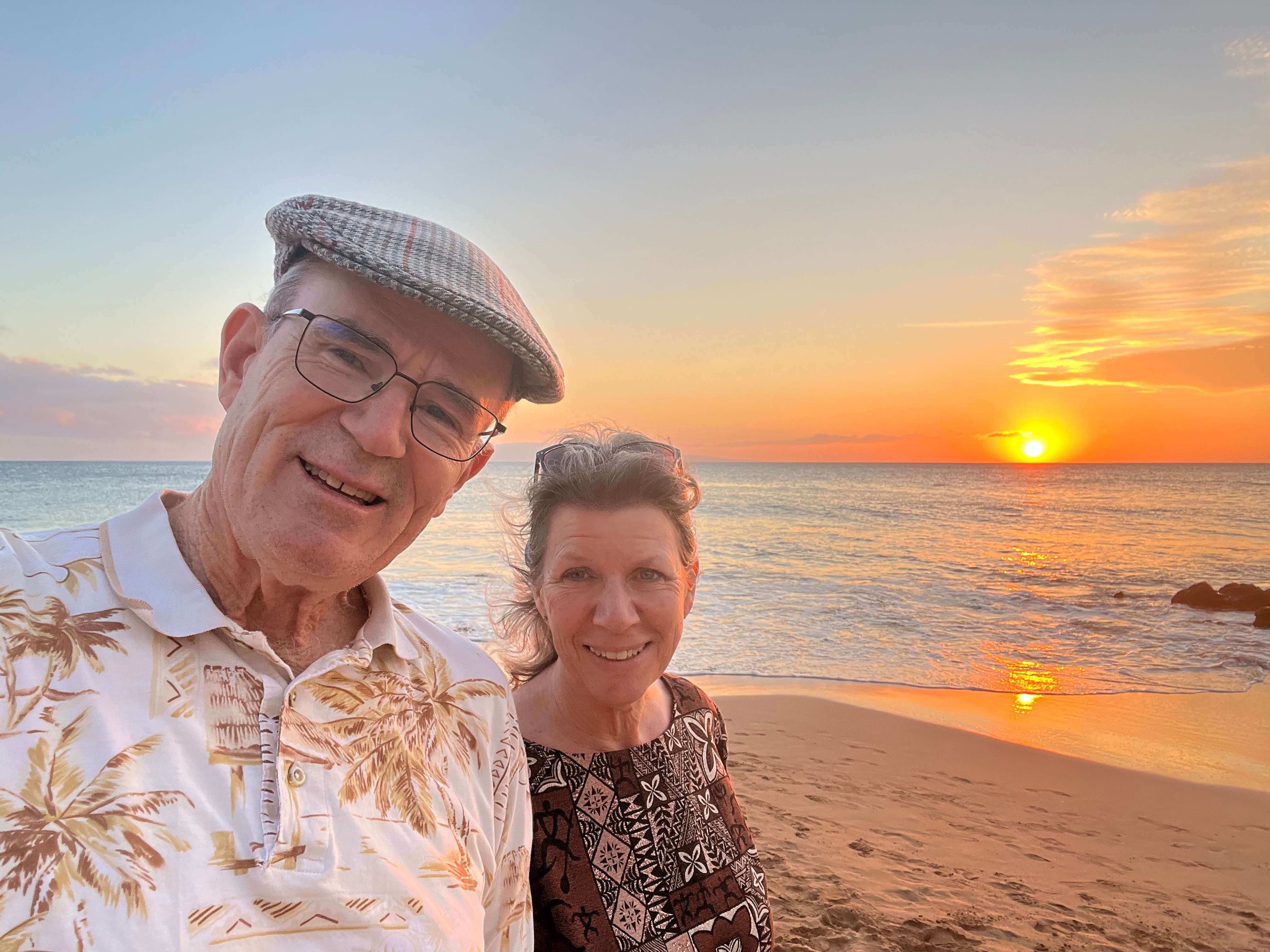
What keeps drawing us to Maui? Most would say it’s the tropical breeze, brilliant rainbows and waterfalls, foot-massaging sandy beaches, or God’s hand in the compelling everchanging sunsets. For us, we wondered, what would it be like to serve the people here? Even more, there was a recurring prompting, some unfinished business, an obligation yet unfulfilled.
On our last visit, January 2025, we attended church as usual. Worshiping with the locals was special because of their love of God and each other, and their Aloha spirit. After partaking of the Sacrament, Brother Sheldon Chinen gave the talk, and spoke about growing up on the island, his conversion to the Gospel of Jesus Christ, those who nurtured his testimony, his career at Hill Air Force Base (AFB) in Utah, and his retirement and return to his home, Maui.
As church concluded we stepped to the end of the pew to intercept Brother Chinen coming down the aisle. We talked about our families, and mentioned that I coincidentally had been working at Hill AFB during the same years he was there. I told him I had also worked part time for Boeing on Maui. “Then you must know Ernest Agcaoili?” he said. That name instantly retrieved good feelings. My eyes widened, “Yes, I sure do know Ernest. He was the lead technician, a smart, wonderful, and kind man.” As I spoke Ernest’s name, I felt I needed to reconnect with him. I sensed that there was some emotion, some experience we had in common beyond just working together. “I’ve lost track of him,” I said. “I know he lived ‘up-country’ in Makawao but I think he’s retired. Do you know how to…” Just then Sheldon pulled out his phone, tapped and swiped, and there on his screen was his friend and youth schoolmate, Ernest Agcaoili. More memories emerged. Thrilled, I captured the contact information, then Joan and I made plans to go visit Ernest and his wife Roxane. As we left the chapel, I recalled the very experience we had had in common. Joan and I decided to go visit them immediately, even that very hour.
In the fall of 2020, four years earlier, Joan and I had a major tragedy in our family. Our son-in-law was serving a neighbor (as he often did) and was working in the metal basket of an elevated lift boom (i.e. cherry-picker) when the support failed and he fell to the ground in the basket. He was severely injured and two weeks later passed away. We lost a son, our daughter lost her beloved husband, and our other children lost their dear brother-in-law. It was a painful time and the hurt continued for a long time.
That next winter, six months later, I was working on the summit of Haleakala helping the team refurbish a massive telescope. Prior to leaving the summit I had a personal visit with Ernest. Outside the building, the cold wet wind blew hard. On the inside Ernest’s warm care calmed the storm, at least for a time, that I felt inside. Ernest turned to me and asked, “How are you doing?” At first I wondered if he was asking about my physical stamina at high altitude, or if he was asking whether I had any COVID-19 symptoms. I then realized that he had heard that I had lost a son-in-law a few months earlier. I replied with equal honesty and respect, “It has been hard. Thank you for asking.” As I expressed myself I soon saw in his eyes that he too was suffering from a major loss.
Three years before this visit on the mountain with Ernest, after receiving his education to work at the same facility we were in, Ernest’s stepson was hit and killed by a car while riding his motorcycle up the mountain to work. Ernest and his wife were devastated. “I’m not the boy’s blood father,” he said, “but it hurts, it still hurts.”. And his wife especially was still in pain. He said that the loss had caused his wife to question her faith. She would ask, “Why did God allow this to happen?”
He explained to her that their son had finished his work and that God had other work for him to do in Heaven. The Spirit filled my heart with love and we talked about ‘The Lord’ as we walked very slowly down the hall. I told him that I receive comfort knowing that when my life is finished I will greet my loved ones in heaven. Then, I told him that I strongly believe that his stepson was greeted by and is with his ancestors. I told him that I believe Ernest’s wife is being prayed for by her ancestors. His eyes expressed appreciation. I thanked him for his care for me and for letting me express care for him. Then spontaneously we said to each other, “I love ya’, brother!”
I never got to meet Ernest’s wife. But as we approached their home this past January, I felt I knew why I needed to see him again, why Joan and I were in that church meeting that day, and why we needed to meet Brother Chinen. We needed to reconnect and express our love and compassion to both Ernest and Roxane.
We’ve driven up the Haleakala Highway from Kahului many times. For some reason we had never turned into the not-so-small community of Makawao, hidden in the hills and medicinal eucalyptus trees on the northern side of the mountain. With some nervousness we found our way to the Agcaoili home. Upon recognizing me, Ernest greeted us warmly, we introduced our wives, and began to visit. We reminisced a little about work, but then he proudly showed his restored antique vehicles in the driveway and garage. Ernest was a skilled mechanic and craftsman at work and at home. The spirit then prompted and I said something like, “Ernest, I have often thought about your kindness when Joan and I lost our son-in-law and I have wanted ever since to express to you, Roxane, our love and compassion for the loss of your son. We hope that you are feeling some comfort in God and that He is helping you.” All eyes teared and the remainder of our visit was filled with love for each other and for The Lord. It was clear that Roxane and Ernest believe in God and have felt his comfort but continue, as all of us do in our losses, to feel the pain while reaching out in faith that all will be well someday. We were all blessed by that tender reunion and knew in our hearts that it was the spirit of God.
We left our new forever friends and descended the mountain with peace and gratitude that we will see our departed loved-ones again. The missionary spirit which filled our hearts made it clear that we indeed wanted to serve the people of Maui, in any capacity, church or community. We later sent a message to Brother Chinon reporting on our wonderful reunion with the Agcaoili’s and the sensitive loving spirit we felt. In the same message we asked Sheldon for contact information on those in the ward or stake to whom we would request the opportunity to serve.
Later, in Utah, Joan revealed one day. “I had an overwhelming feeling of comfort that it was the right thing to do. I wasn’t asking, it just came, a spirit washed over me with love and peace.” And just recently I found my journal entry from that night four years ago on the mountain with Ernest. At the end of our visit I had offered to help him and his wife learn more about their ancestors. To which he nodded favorably. “Ah,” I thought. “Perhaps that is some of the unfinished business we needed to do, to help them learn of their ancestors.” And so we go forward having worked here and having played here. Now with spiritual confirmation, we go forth to serve here.

 “Mother gave an Indian a whack with an iron poker for stealing her biscuits hot from the oven, and a papoose a whipping for shooting her ducks with a bow and arrow. The mother of the papoose went mumbling around their camp saying that Mother had wronged her papoose. So Mother went to Washakie, the Chief, and Washakie gave the squaw and papoose ‘heck’…


 AncestorClips